22 Tomato Plant Diseases: The Complete Guide to Identification, Treatment, and Prevention
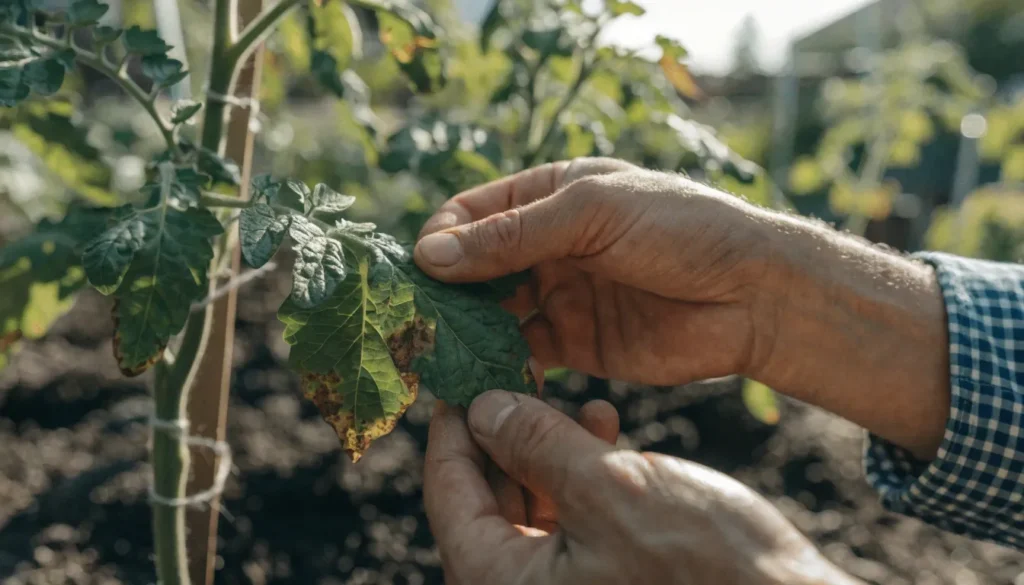
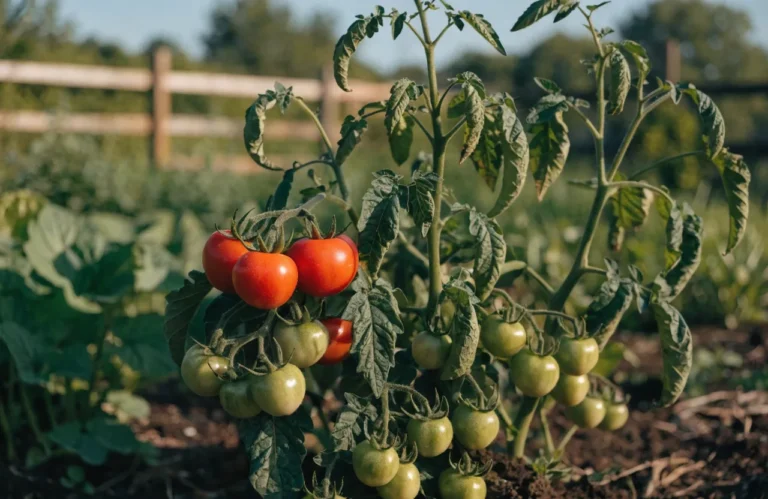
Tomatoes are among the most popular crops in home gardens and commercial farms alike, but they’re also magnets for tomato diseases, fungal infections, and environmental stress. Most outbreaks of tomato leaf disease or fruit rot trace back to a handful of root causes: excess moisture on foliage, poor air circulation, contaminated soil, and stressed or nutrient-deficient plants. Knowing what you’re looking at, and catching a tomato plant infection early, is the difference between losing a few leaves and losing the whole crop.
This guide organizes the most common tomato plant diseases and disorders by category, with symptoms, causes, treatments, and prevention for each, plus symptom-based navigation, severity rankings, spread mechanisms, a seasonal calendar, regional notes, and answers to frequently asked questions. If you’re growing tomatoes in containers, many of the same principles apply, see our guide on how to grow tomatoes in pots for setup-specific advice.
Table of Contents
Find Your Tomato Problem
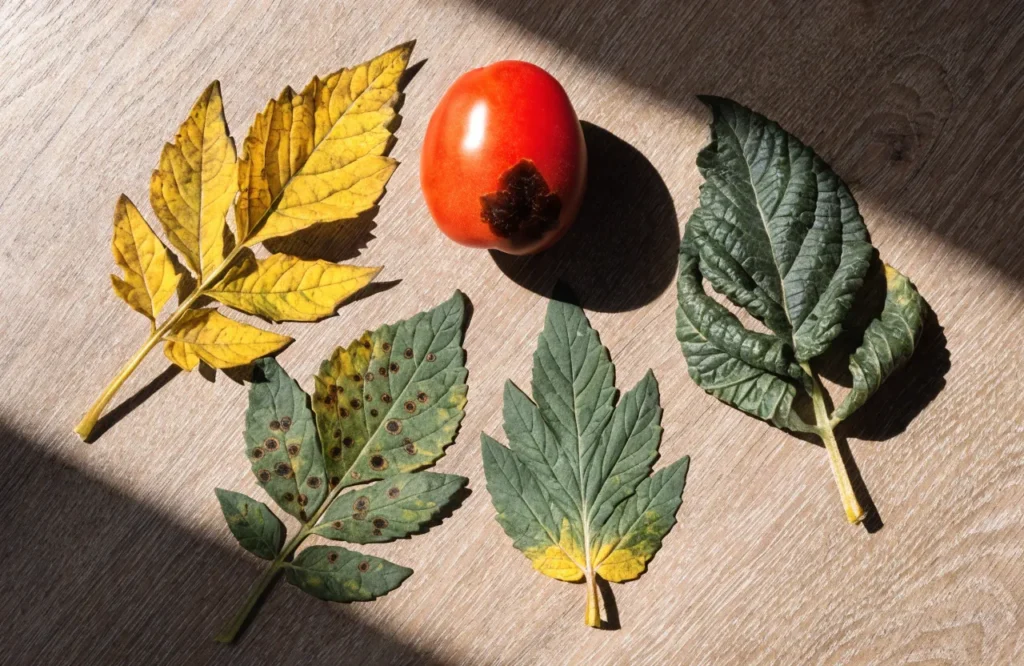
Not sure what you’re dealing with? If you don’t know the name of the disease, start here and match what you’re seeing to the likely cause. Each links to a fuller entry below.
| If your tomato plant has… | It’s likely… |
| Yellow lower leaves that spread upward | Early blight, Fusarium wilt, or Verticillium wilt |
| A white, powdery coating on leaves | Powdery mildew |
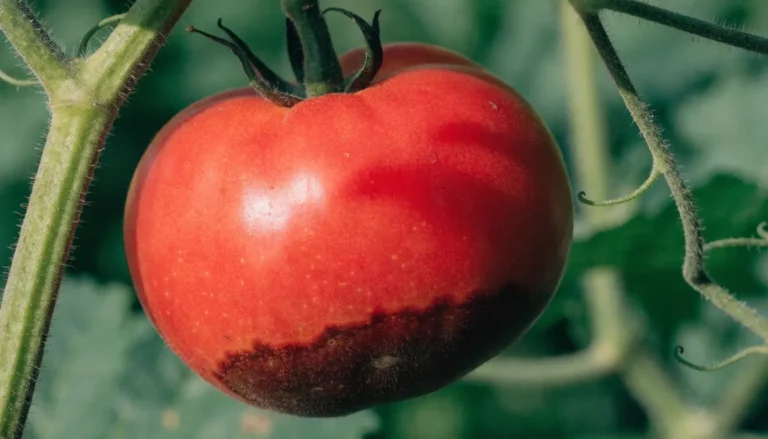
| A black, sunken spot at the bottom of the fruit | Blossom end rot |
| Sudden, total wilting of the whole plant | Bacterial wilt |
| Concentric brown rings on fruit | Buckeye rot or anthracnose |
| Mottled, curling, distorted leaves | Mosaic virus |
| Small yellow leaves curling upward | Tomato yellow leaf curl virus |
| Greasy brown blotches with white fuzz | Late blight |
| Gray, fuzzy mold on stems or fruit | Botrytis (gray mold) |
| Pale, blistered patches on sun-facing fruit | Sunscald |
| Small dark specks with yellow halos | Bacterial speck or bacterial spot |
| Stunted plant with swollen, galled roots | Root-knot nematodes |
| Cracks radiating from the fruit’s top | Growth cracking (watering-related) |
Quick-Reference Table: Common Tomato Plant Diseases
| Disease | Type | Key Symptom | Primary Treatment |
| Early blight | Fungal | Dark, ringed spots on lower leaves | Prune affected foliage, apply fungicide |
| Septoria leaf spot | Fungal | Small gray-brown leaf spots with dark margins | Fungicide, remove debris |
| Fusarium wilt | Fungal | One-sided yellowing and daytime wilting | Resistant varieties, crop rotation |
| Verticillium wilt | Fungal | Yellow blotching, upward-progressing wilt | Resistant varieties, sanitation |
| Powdery mildew | Fungal | White powdery coating on leaves | Sulfur, fungicides, horticultural oil |
| Anthracnose | Fungal | Sunken, concentric-ringed fruit rot | Copper fungicide, prompt harvest |
| Botrytis (gray mold) | Fungal | Gray-brown fuzzy growth on stems/fruit | Fungicide for gray mold, pruning for airflow |
| Leaf mold | Fungal | Yellow-green leaf spots with gray fuzz underneath | Improve air circulation, avoid wetting leaves |
| Southern blight | Fungal | Stem lesions at the soil line, white mold | Soil solarization, fungicide, rotation |
| Gray leaf spot | Fungal | Small dark leaf spots with yellow halos | Resistant varieties, remove debris |
| Late blight | Oomycete | Greasy brown blotches with white mold | Copper spray, resistant varieties |
| Buckeye rot | Oomycete | Concentric brown rings on fruit | Avoid soil contact, staking |
| Bacterial speck | Bacterial | Tiny dark specks with yellow halos | Copper fungicide |
| Bacterial spot | Bacterial | Greasy, scabby spots on leaves and fruit | Certified seed, copper sprays |
| Bacterial wilt | Bacterial | Sudden, total plant wilting | Remove infected plants, rotate crops |
| Bacterial canker | Bacterial | “Bird’s-eye” spots on fruit, one-sided wilt | Certified seed, sanitation |
| Tomato/tobacco mosaic virus | Viral | Mottled, curling leaves | No cure — resistant varieties, sanitation |
| Tomato spotted wilt virus | Viral | Bronzed leaves, ringed spots on fruit | Control thrips populations |
| Tomato yellow leaf curl virus | Viral | Small, upward-curling yellow leaves | Control whiteflies, resistant varieties |
| Blossom end rot | Physiological | Black, sunken area at fruit’s blossom end | Consistent watering, calcium (lime) |
| Sunscald | Physiological | Pale, blistered patches on sun-exposed fruit | Maintain foliage cover, shade cloth |
| Root-knot nematodes | Nematode | Stunted growth, galled roots | Resistant varieties, crop rotation |
Comparing Disease Categories: How to Tell Them Apart
If you’re trying to narrow down whether you’re facing a tomato fungus, a bacterial problem, or a virus, the pattern of symptoms is your best clue. This table compares the four broad categories at a glance.
| Category | Typical Cause | Where It Usually Shows Up | Spreads Via | Curable? |
| Fungal | Airborne or soil-dwelling fungi | Lower leaves first, then fruit and stems | Wind, water splash, contaminated soil | Often manageable with fungicide if caught early |
| Oomycete (water mold) | Fungus-like water molds | Leaves and fruit, especially in wet weather | Wind-driven rain, splashing water | Preventable; hard to reverse once established |
| Bacterial | Soil or seed-borne bacteria | Small spots/specks on leaves and fruit, or sudden wilting | Splashing water, contaminated tools/seed | No cure — remove infected plants |
| Viral | Plant viruses | Leaf mottling, curling, distortion | Insects (aphids, whiteflies, thrips), contaminated tools | No cure — prevention only |
| Physiological (non-pathogen) | Watering, nutrients, temperature, sun exposure | Fruit (rot, cracking, scalding) or leaf color | Not contagious | Fixable by adjusting growing conditions |
Tomato Disease Severity & Action Table
Not every spot on a leaf calls for the same response. This table ranks common problems by how urgently they need action, so you can decide whether to simply monitor, treat right away, or pull the plant.
| Severity | Examples | Recommended Action |
| Low, cosmetic or self-limiting | Catfacing, edema, gray wall, minor sunscald, water-stress leaf curl | Monitor; usually no treatment needed, just adjust watering or shading |
| Moderate, manageable with treatment | Early blight, Septoria leaf spot, powdery mildew, anthracnose, blossom end rot | Remove affected leaves/fruit, treat with fungicide or adjusted watering/calcium, keep monitoring |
| High, spreads quickly, needs prompt action | Late blight, Botrytis (gray mold), leaf mold, bacterial spot, bacterial speck | Treat immediately, isolate or remove the worst-affected plants, improve airflow and stop overhead watering |
| Critical, no cure, remove plant | Fusarium wilt, Verticillium wilt, bacterial wilt, bacterial canker, mosaic virus, TSWV, TYLCV, Southern blight | Remove and destroy the plant promptly; focus on protecting the rest of the garden and the soil for future seasons |
How Diseases Spread
Understanding a disease’s transmission route tells you exactly which habit to change to stop it. This table groups common tomato problems by how they typically move from plant to plant.
| Spread Mechanism | Diseases That Travel This Way | What It Means for You |
| Water splash (rain, overhead irrigation, hose spray) | Early blight, Septoria leaf spot, late blight, bacterial speck, bacterial spot | Switch to drip irrigation or water at the soil line; avoid working around wet plants |
| Wind-blown spores | Powdery mildew, late blight, gray leaf spot | Space plants for airflow; treat preventively during humid, breezy weather |
| Contaminated soil (persists between seasons) | Fusarium wilt, Verticillium wilt, Southern blight, root-knot nematodes, buckeye rot | Rotate crops for at least two to three years; consider soil solarization in known hot spots |
| Insects (aphids, whiteflies, thrips, leafhoppers) | Mosaic viruses, TSWV, TYLCV, curly top virus | Control the insect vector directly — the virus itself can’t be treated once a plant is infected |
| Contaminated tools, hands, or stakes | Mosaic virus, bacterial canker, bacterial wilt | Sanitize pruners and stakes between plants, especially after touching a symptomatic one |
| Infected seed or transplants | Bacterial canker, bacterial spot, mosaic virus | Buy certified disease-free seed and transplants from a reputable source |
| Direct soil contact with fruit | Anthracnose, buckeye rot, Southern blight | Stake or cage plants, mulch, and remove the lowest leaves so fruit doesn’t touch bare soil |
Fungal Diseases (Tomato Fungus Problems)
Fungal pathogens cause the majority of tomato plant diseases, and most thrive in warm, humid, or wet conditions where water sits on leaves and stems for extended periods.
Early Blight
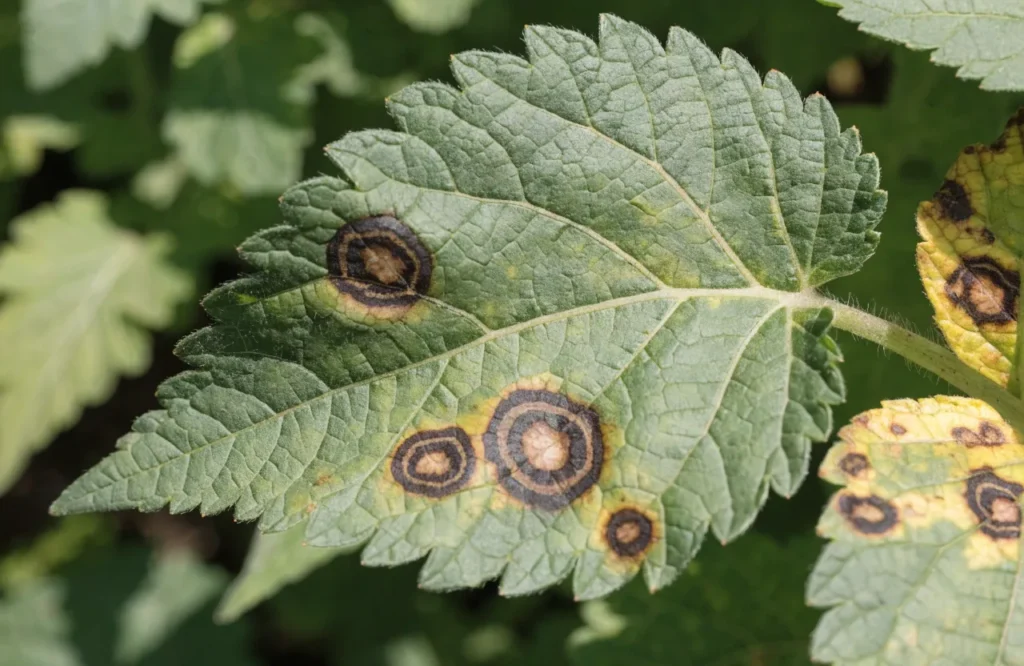
Caused by the fungus Alternaria solani (sometimes classified as A. linariae), early blight is arguably the most common tomato leaf spot problem. It shows up as dark, irregular spots, often with a target-like ring pattern, on the oldest, lowest leaves first, then works its way up the plant. Infected leaves eventually yellow, shrivel, and drop, and the resulting loss of foliage exposes fruit to sunscald. Stems can develop cankers, and fruit may show small, dark, sunken lesions near the stem end.
Treatment: Remove and destroy infected lower leaves (don’t compost them), and apply a fungicide labeled for early blight as soon as symptoms appear.
Prevention: Water at the soil line rather than overhead, mulch to prevent soil splash, space plants for airflow, stake or cage them, and rotate tomatoes and other nightshades (peppers, potatoes, eggplant) out of that bed for two to three years.
Septoria Leaf Spot
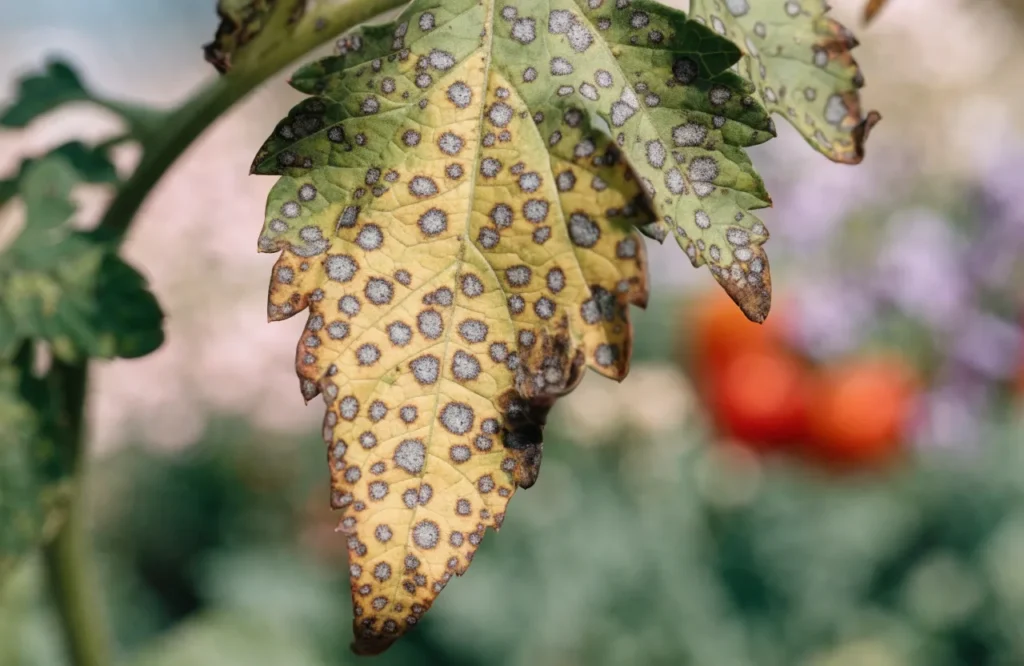
Septoria leaf spot is caused by the fungus Septoria lycopersici and often appears around the time the first fruit sets. Look for numerous small, round tomato leaf spots with tan or gray centers and dark margins on lower leaves; tiny black specks (the fungus’s fruiting bodies) are often visible in the center of each spot. It spreads fast in wet weather and frequently shows up alongside early blight.
Treatment: Remove infected leaves, and apply a fungicide or biofungicide repeatedly through the season; copper sprays offer partial control.
Prevention: Clear fallen leaves and plant debris promptly, disinfect tools, water at the soil line, and rotate crops every three years.
Fusarium Wilt
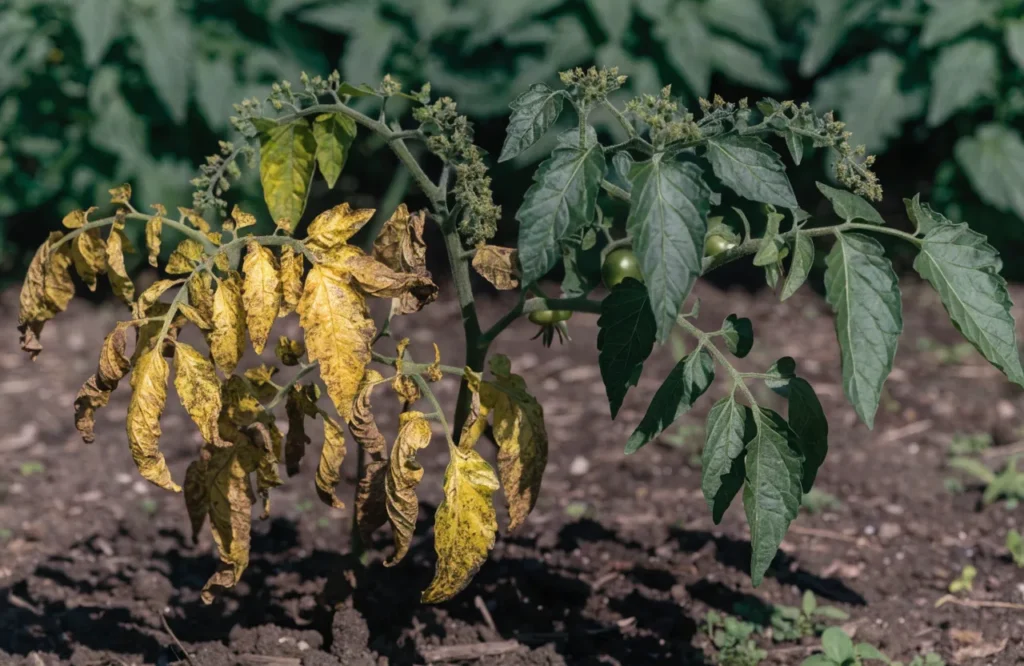
Fusarium oxysporum f. sp. lycopersici is a soil-dwelling fungus that clogs a plant’s water-conducting tissue, causing a distinctive tomato plant wilting pattern. The telltale sign is one-sided yellowing: leaves on just one side of a leaf or stem wilt and turn yellow, often recovering somewhat at night before worsening again over days or weeks. Slicing open a stem reveals brown discoloration inside.
Treatment: There’s no fungicide cure. Remove and destroy infected plants; the fungus can persist in soil for years even though it doesn’t spread further within the same season’s remaining plants.
Prevention: Plant varieties labeled with disease-resistance codes (look for “F” or “FN” on seed packets), rotate crops for at least three years, sanitize tools, and avoid excess nitrogen fertilizer.
Verticillium Wilt
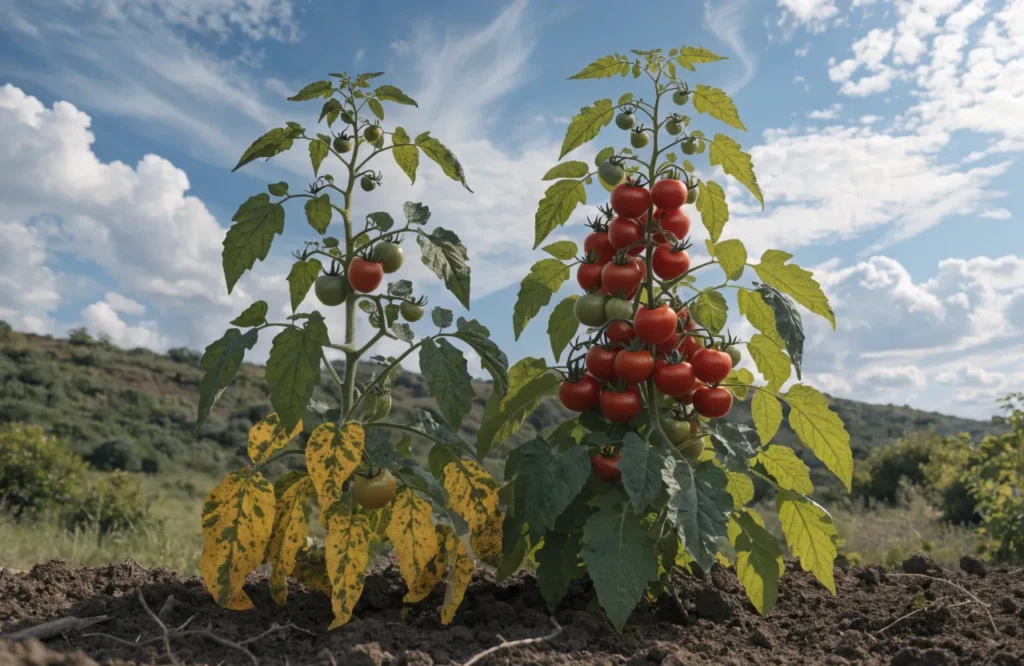
Verticillium wilt looks similar to Fusarium wilt and is caused by a related but distinct soil fungus (Verticillium species). Yellow blotching appears on lower leaves first and spreads upward as the plant’s leaves turn yellow and its veins darken; the plant becomes stunted, though new growth at the top often stays green. Losing lower foliage leaves fruit vulnerable to sunscald.
Treatment: No fungicide will cure it, remove severely affected plants.
Prevention: Choose resistant varieties (labeled “V”), disinfect equipment regularly, and rotate away from susceptible crops.
Powdery Mildew
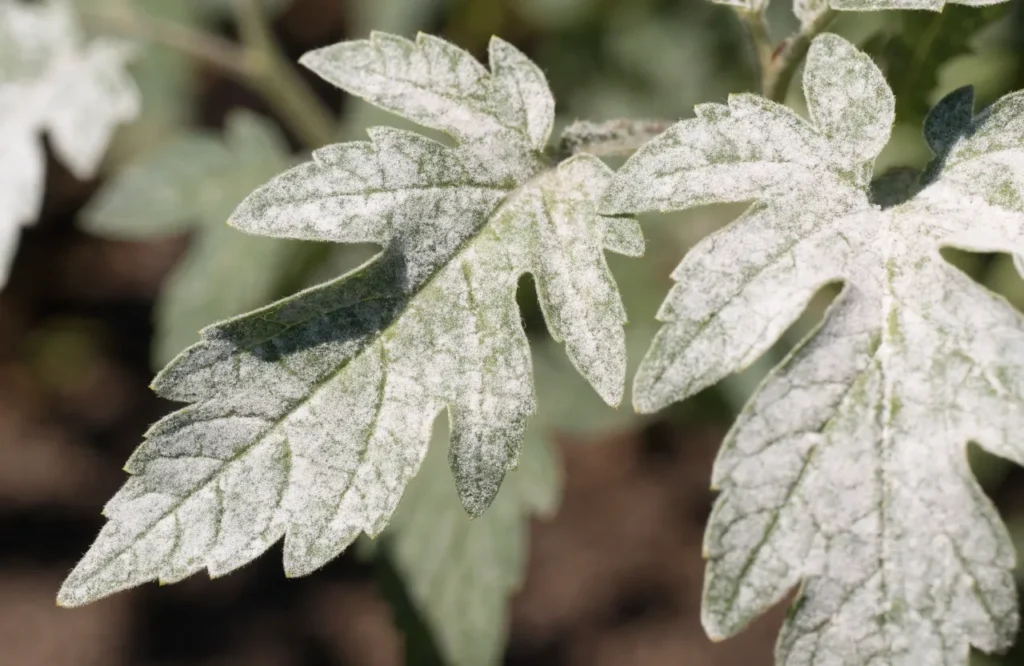
Powdery mildew is caused by airborne fungal spores and is unusual among tomato plant fungus problems because high humidity, not necessarily wet leaves, is what drives outbreaks. It doesn’t infect fruit directly, but heavy leaf loss leads to sunscald.
Treatment: Apply sulfur dust, a fungicide, a biofungicide, or horticultural oil across the whole crop, and remove infected leaves.
Prevention: Space plants for airflow, prune for better circulation, and water consistently at the soil line.
Anthracnose
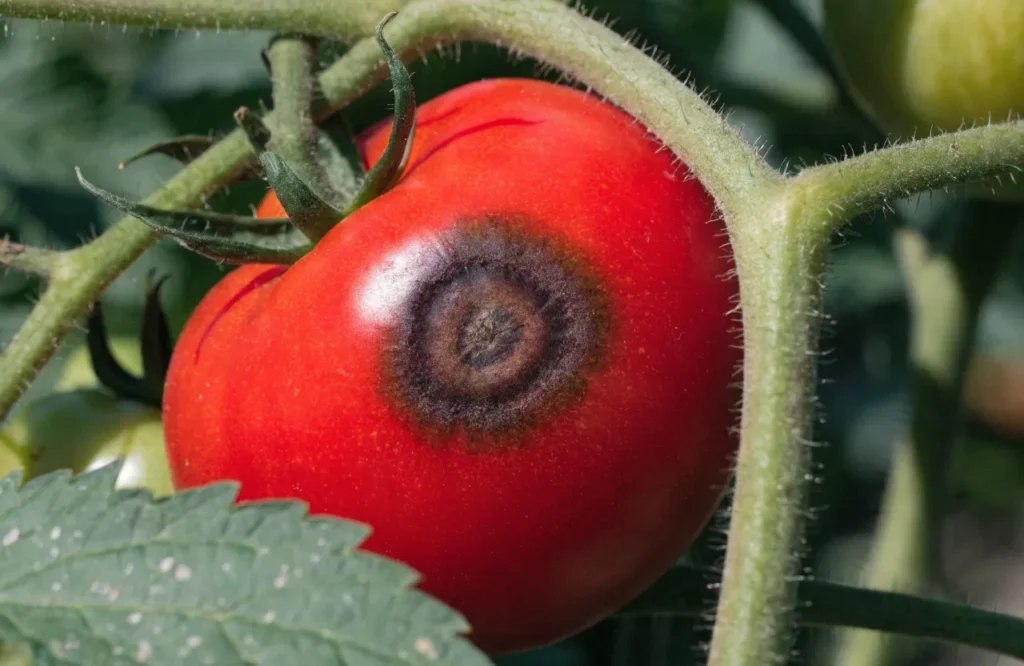
Anthracnose is caused by fungi in the Colletotrichum genus and thrives in warm, wet conditions, especially where fruit contacts damp soil, often resulting in tomato fruit rot. Infected fruit, usually overripe fruit, develops small, sunken, water-soaked spots that expand into concentric rings and eventually rot.
Treatment: Copper-based fungicides work best as a preventive measure applied at the first sign of trouble.
Prevention: Stake plants, mulch, remove lower leaves to limit soil contact, harvest fruit promptly once ripe, and rotate crops every two years.
Botrytis (Gray Mold)
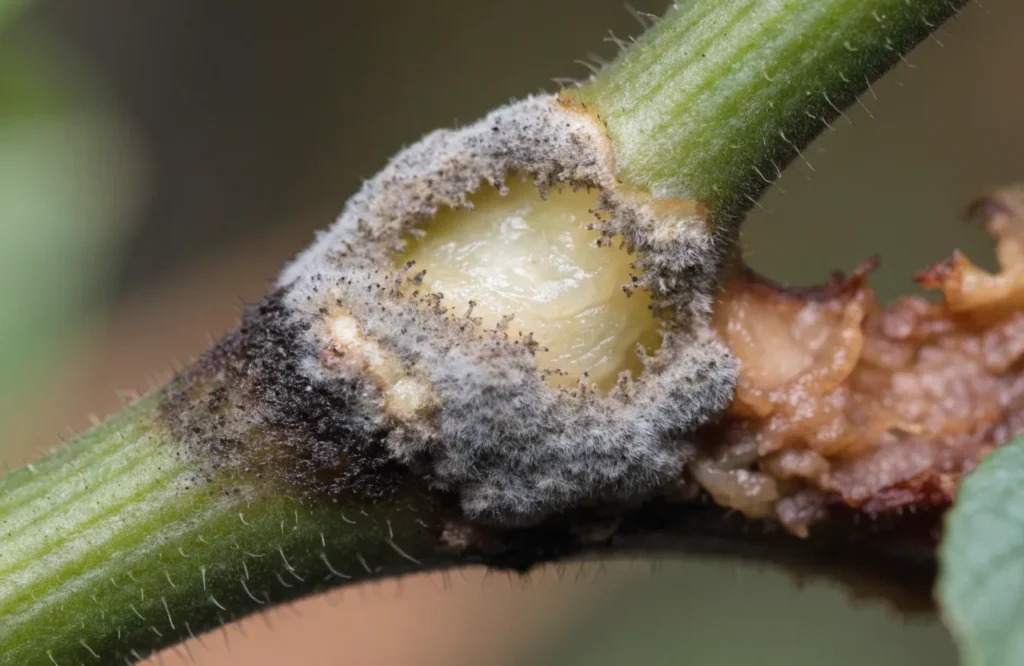
Caused by Botrytis cinerea, this fungus enters through wounds or pruning cuts and can lie dormant for weeks before symptoms appear. It favors cooler, humid conditions and produces fuzzy gray-brown growth on stems, leaves, and fruit; girdled stems cause everything above the lesion to wilt.
Treatment: A fungicide or biofungicide formulated specifically for gray mold; the disease often subsides on its own as temperatures rise.
Prevention: Prune in early afternoon so cuts dry quickly, avoid overhead watering, and space plants well.
Leaf Mold
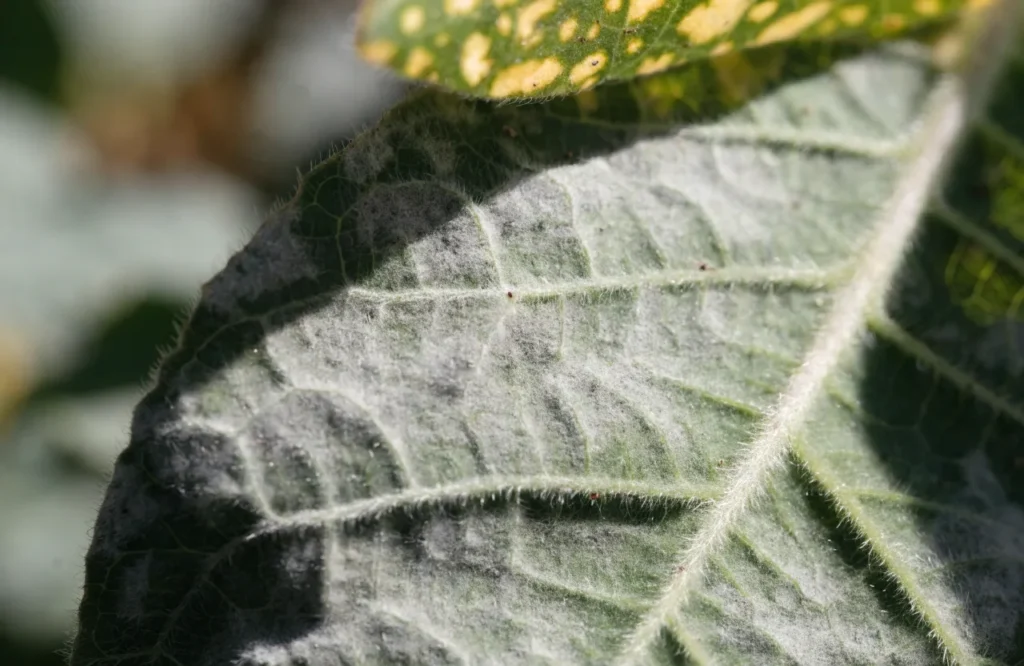
Leaf mold, caused by the fungus Passalora fulva, is especially common in humid greenhouse conditions and is a frequent cause of tomato leaf disease indoors. Pale green-yellow spots appear on upper leaf surfaces, with a gray, velvety fungal growth developing on the undersides.
Treatment: Improve air circulation through pruning and spacing, and avoid wetting foliage. Prevention: Rotate crops and consider a preventive fungicide in humid climates or greenhouses.
Southern Blight
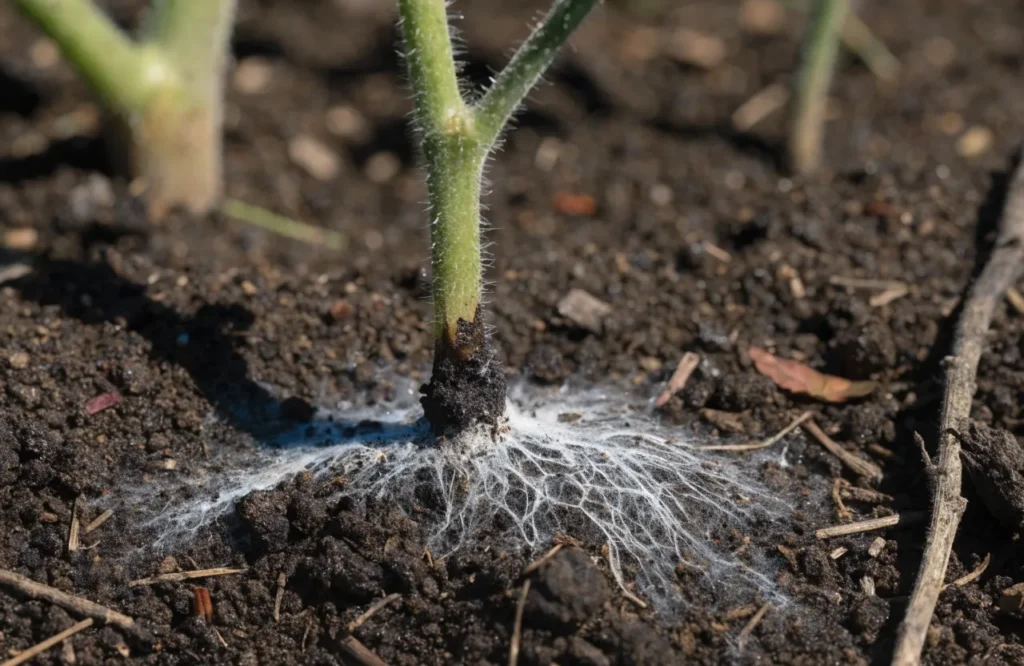
Athelia rolfsii (also called Sclerotium rolfsii) is a soil fungus that girdles stems near ground level, cutting off water and nutrient flow, another common cause of tomato leaf blight and stem collapse. It’s more common in warm southern climates and can persist in soil for years, also affecting peppers, beans, and several other crops.
Treatment: Fungicides and biofungicides can help; soil fumigants are effective but costly. Prevention: Solarize soil before planting, till in plant debris, maintain appropriate soil pH, and rotate away from host crops.
Gray Leaf Spot
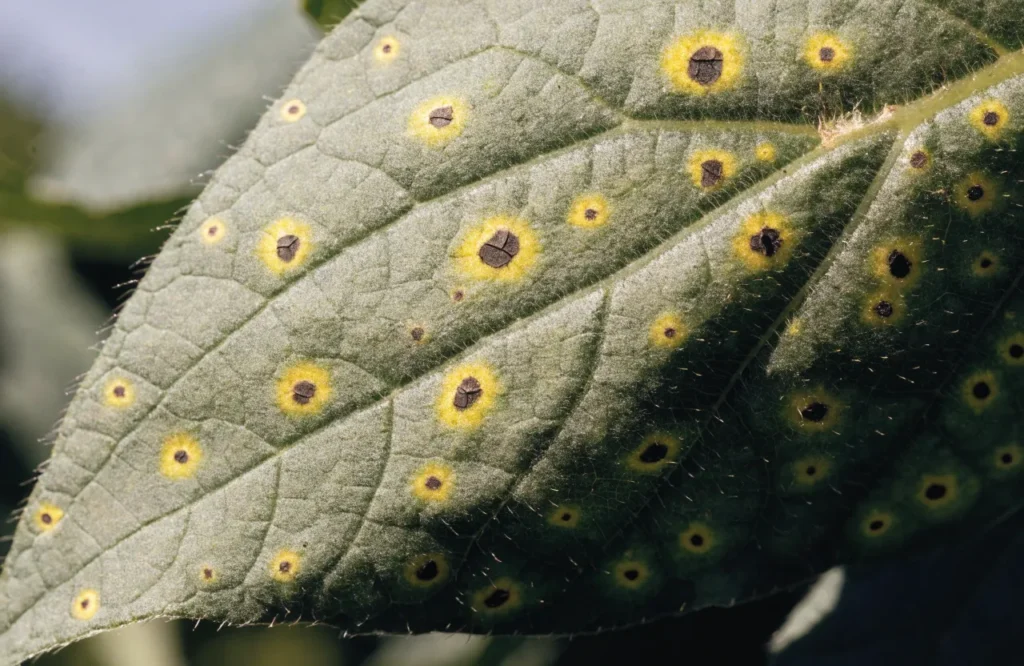
This fungal disease mainly targets leaves, starting with the oldest, and rarely infects fruit directly, though it inhibits fruit production. Small dark leaf spots ringed with yellow halos enlarge, crack in the center, and eventually cause leaf drop. Cherry and grape tomatoes are especially susceptible.
Treatment: Remove affected plants and garden debris (don’t compost infected material). Prevention: Choose resistant varieties and rotate crops.
Oomycete (Water Mold) Diseases
Oomycetes, sometimes called water molds, aren’t true fungi but cause a similar tomato leaf blight and fruit rot, especially in wet weather.
Late Blight
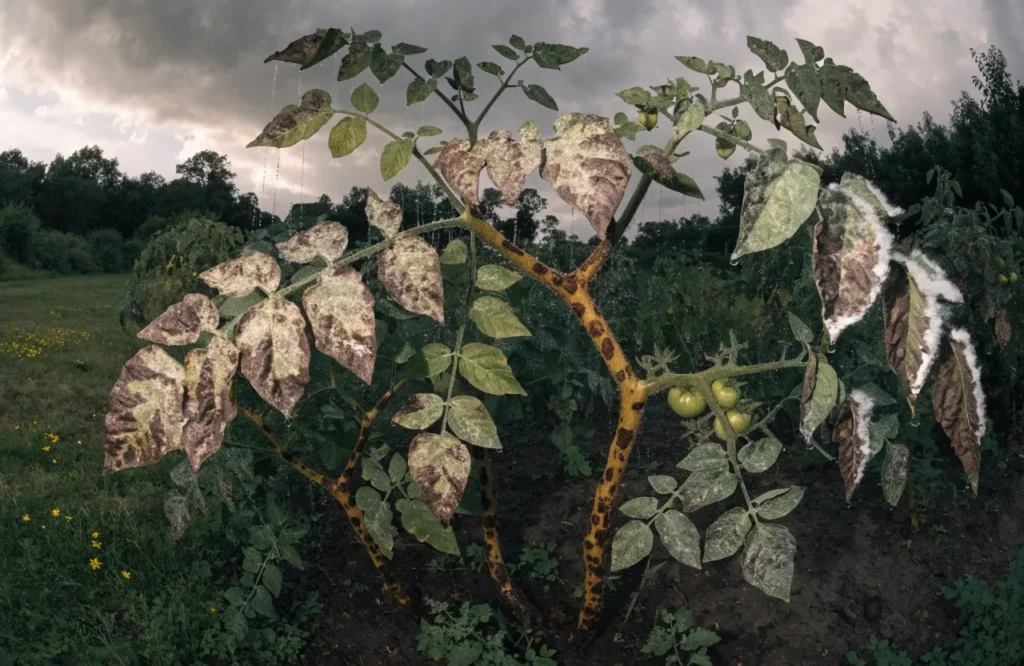
Late blight, caused by Phytophthora infestans, is one of the most destructive tomato leaf blight diseases and can wipe out a planting quickly in cool, wet conditions. Greasy, irregular dark blotches with pale edges appear on leaves, often surrounded by white mold in humid weather; fruit develops large, greasy gray-brown patches and can turn mushy from secondary infection.
Treatment: Copper sprays provide some control, and products like Serenade work better as prevention than cure. Remove all infected debris promptly.
Prevention: Plant resistant varieties, rotate crops annually, space plants for airflow, and prune to keep foliage from touching.
Buckeye Rot
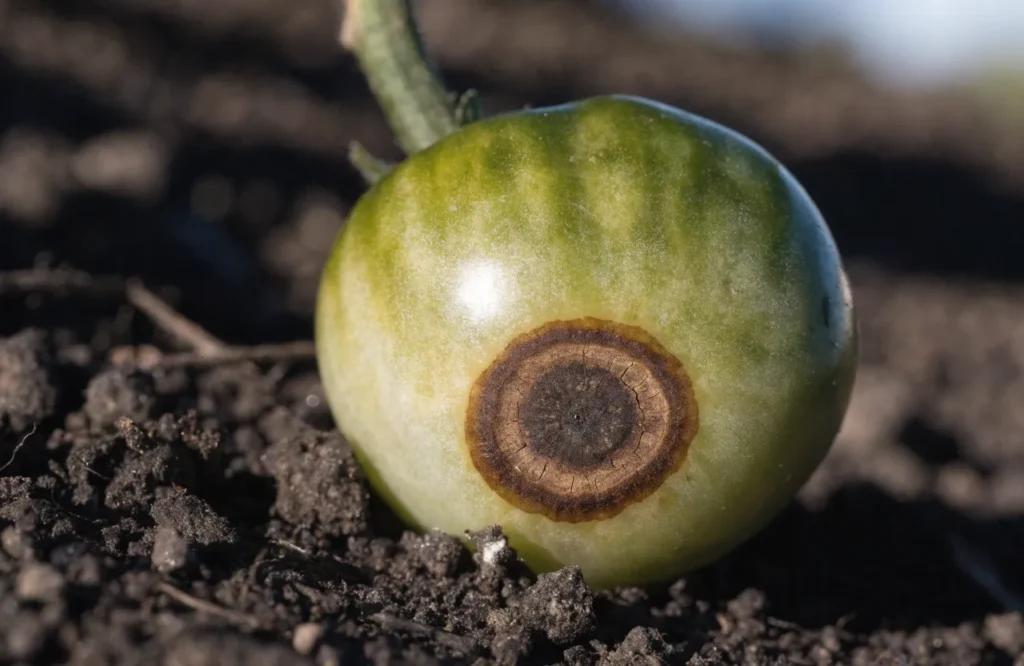
Related to late blight, buckeye rot (Phytophthora species) thrives in warm, wet conditions, particularly in southern growing regions, and is a common cause of tomato fruit rot near the soil line. It causes brown spots on fruit that expand into concentric rings resembling a buckeye seed, eventually softening and decaying. It can affect both green and ripe fruit that touches wet soil.
Treatment: Remove affected fruit and avoid letting water pool or flood around plants. Prevention: Stake or cage plants to keep fruit off the ground, and ensure excellent soil drainage.
Bacterial Diseases
Bacterial tomato plant infections spread easily through splashing water, contaminated seed, and garden tools, and none have a true cure once established, management focuses on limiting spread.
Bacterial Speck
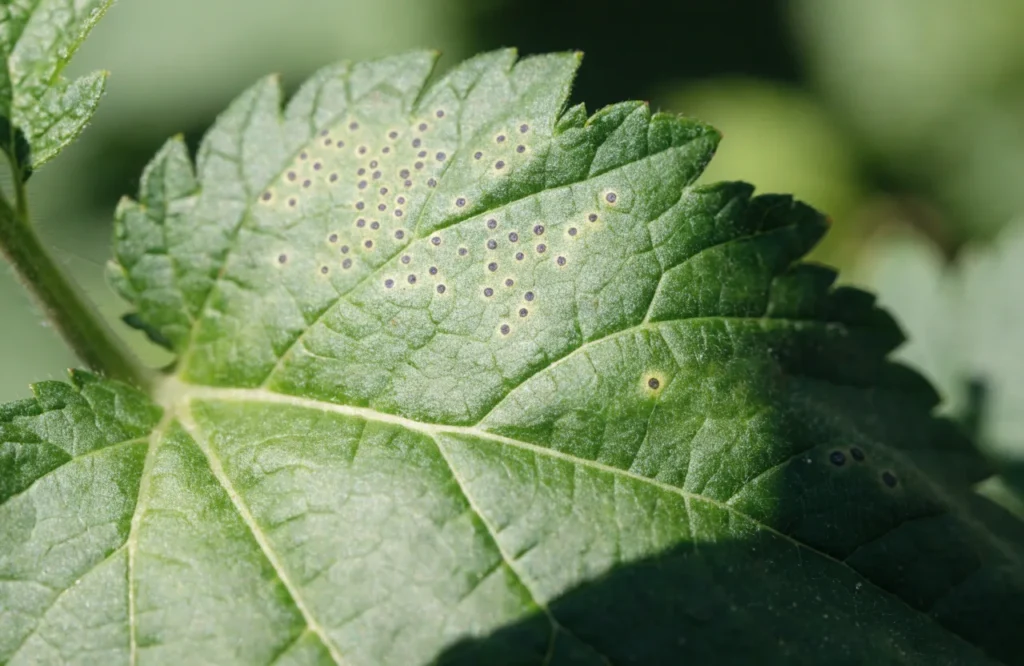
Caused by Pseudomonas syringae, bacterial speck favors cool, wet weather. It produces small, dark specks on leaves, often with a yellow halo, and raised, scaly lesions on fruit.
Treatment: Copper fungicide applications during cool, wet spells; hot weather naturally slows the pathogen.
Prevention: Delay planting until conditions are warmer and drier, avoid overhead watering, and rotate crops annually.
Bacterial Spot
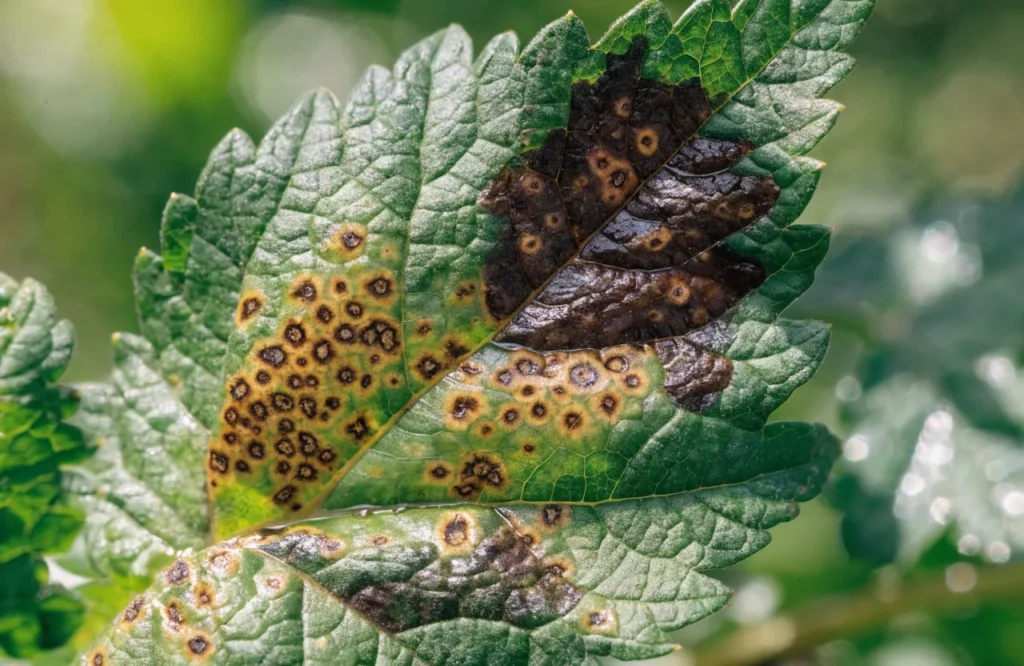
Multiple Xanthomonas species cause bacterial spot, which is favored by hot, humid weather. Small water-soaked tomato leaf spots multiply and merge into blighted patches; fruit develops raised, scabby lesions.
Treatment: Remove infected plants and avoid eating fruit from heavily infected plants, since secondary pathogens can take hold.
Prevention: Use certified disease-free seed and transplants, water at the base of the plant, remove crop debris, and rotate crops.
Bacterial Wilt
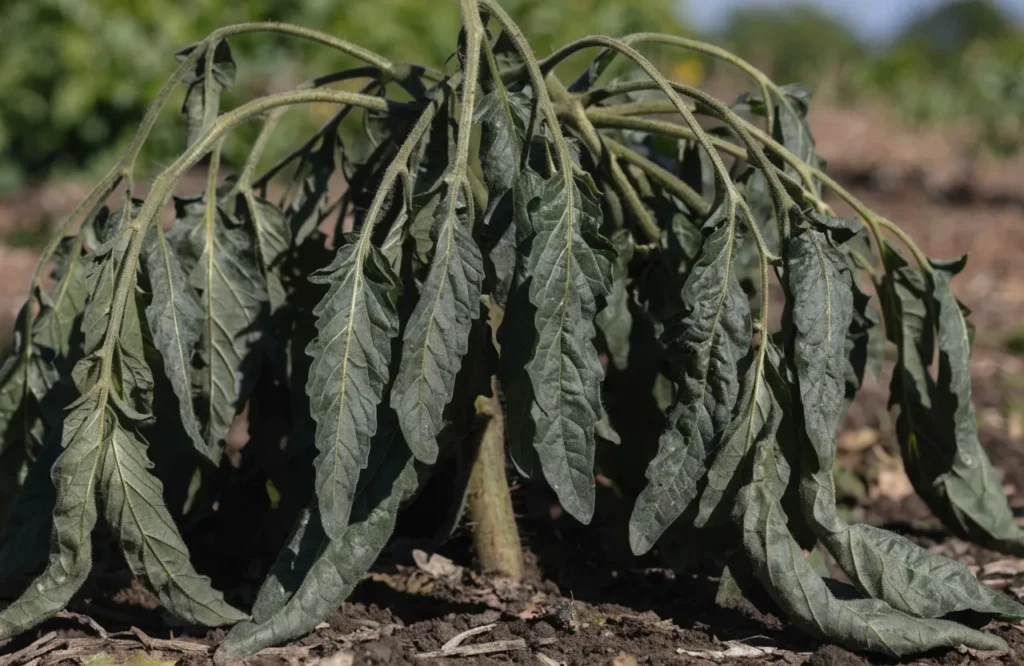
Ralstonia solanacearum causes a rapid, often fatal case of tomato plant wilting that’s especially damaging in hot, tropical, and subtropical regions. Younger leaves wilt first, and in warm weather the whole plant can collapse within days. Cutting a stem and placing it in water reveals a milky bacterial ooze, which distinguishes it from Fusarium wilt.
Treatment: There is no effective treatment once plants are infected, remove and destroy them immediately.
Prevention: Rotate away from susceptible crops, avoid overwatering, and sanitize tools.
Bacterial Canker
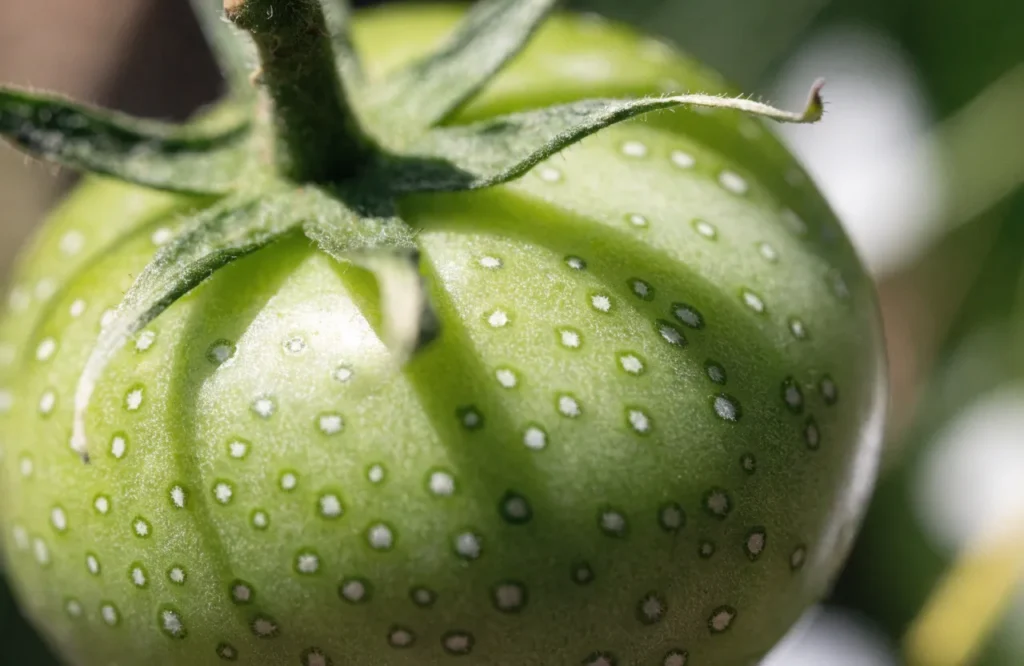
Clavibacter michiganensis can kill seedlings quickly and cause serious losses in mature plants. Look for one-sided wilting, light streaks along leaf midribs and stems, and small white fruit spots that develop a raised, dark center known as a “bird’s-eye” spot.
Treatment: Remove and destroy infected plants; there’s no cure.
Prevention: Use only certified seed and transplants, rotate crops away from host plants, and turn under crop debris after harvest to speed decomposition.
Viral Tomato Diseases
Viral tomato plant infections are typically spread by insects, contaminated tools, or infected seed and have no chemical treatment, prevention and resistant varieties are the only real defense.
Mosaic Viruses (Tomato Mosaic Virus / Tobacco Mosaic Virus)
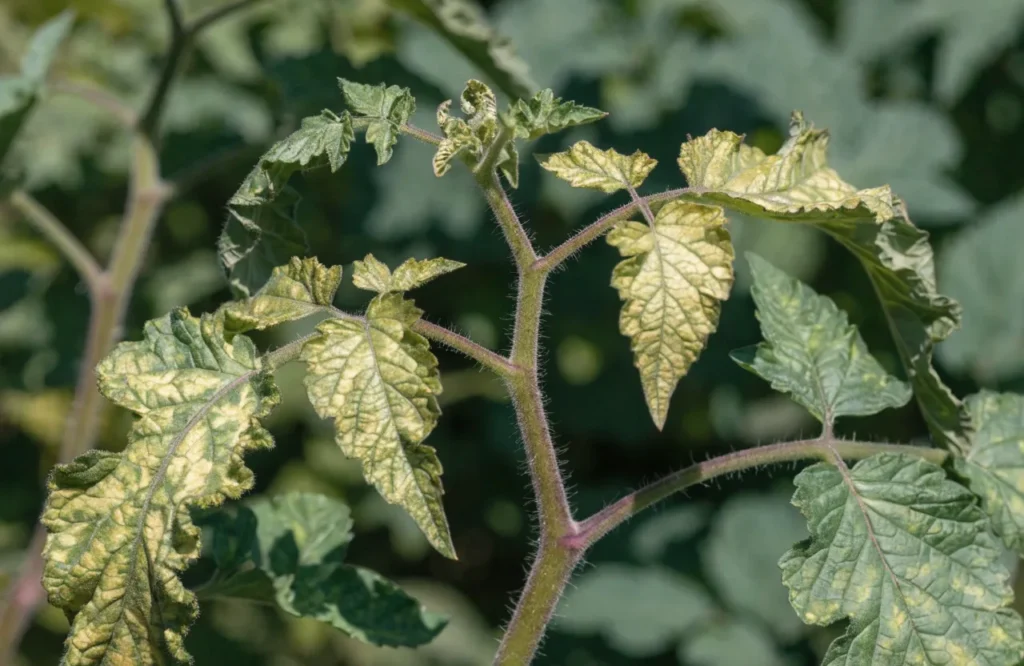
These closely related viruses are a classic cause of tomato leaves curling and mottling, with young growth sometimes stunted. Infected fruit may show yellow blotches or dark streaks. The viruses can persist in plant debris for decades and spread through handling, grafting, and contaminated tools. Smokers should wash their hands before touching plants, since tobacco products can carry the virus.
Treatment: None, remove and destroy infected plants.
Prevention: Plant resistant varieties, disinfect tools between plants, and rotate away from other susceptible crops like peppers and eggplant.
Tomato Spotted Wilt Virus (TSWV)
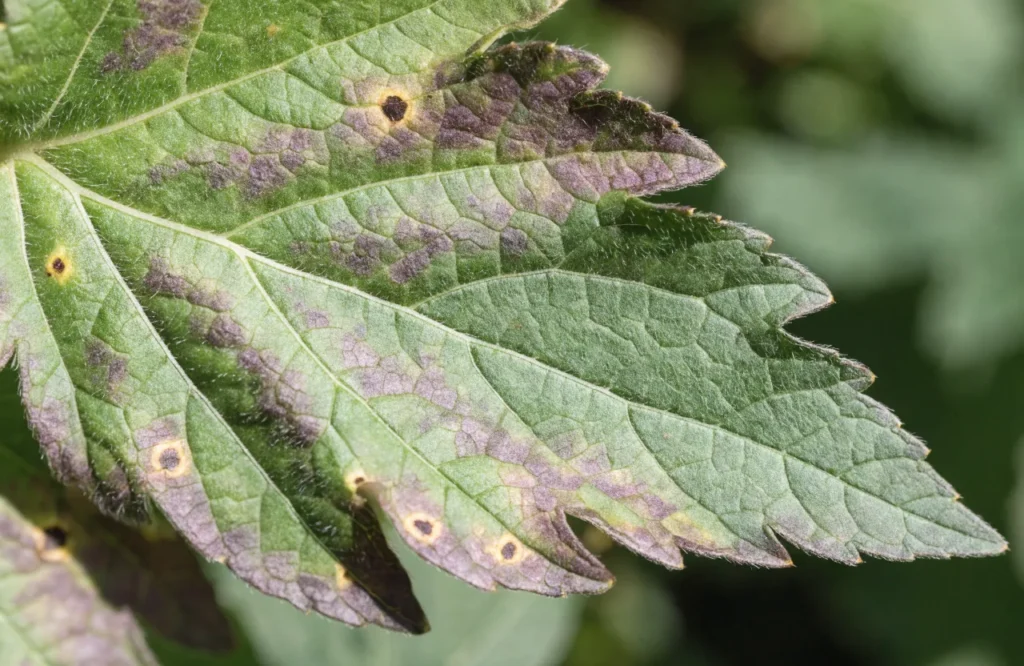
Spread by thrips, TSWV causes bronzing or purpling on young leaves, necrotic spots, and downward-cupping foliage. Ripe fruit develops chlorotic spots and rings, and green fruit may show faint concentric zoning.
Treatment: None, focus on controlling the thrips that spread it.
Prevention: Manage thrips populations and remove infected plants promptly.
Tomato Yellow Leaf Curl Virus (TYLCV)
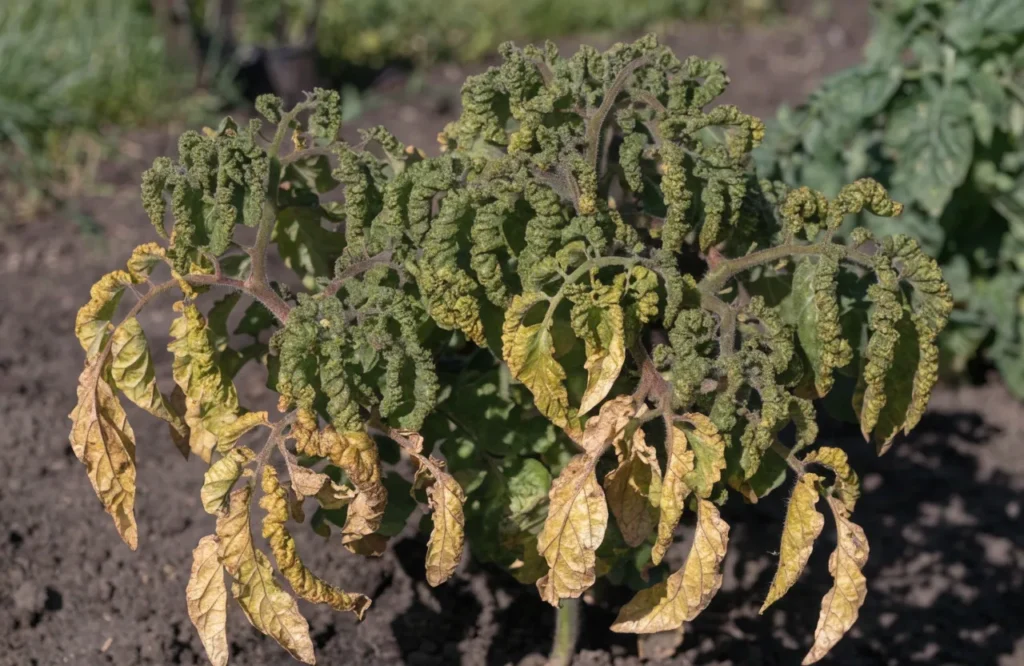
Transmitted by whiteflies, this virus is one of the most common reasons for a tomato plant turning yellow with small, curling leaves; it stunts plants and shortens the space between leaf nodes, giving them a bushy, upright look. Leaves stay small, curl upward, and yellow along the veins and margins; flowers often drop before setting fruit. Infections early in a plant’s life can cause total yield loss.
Treatment: None, remove and destroy infected plants.
Prevention: Aggressive crop rotation, whitefly control (including yellow sticky traps), weed management, and planting only whitefly-free transplants.
Physiological Disorders (Not Caused by Pathogens)
Some of the most common tomato problems aren’t disease at all, they’re the plant’s response to environmental stress, uneven watering, or nutrient imbalances.
Blossom End Rot
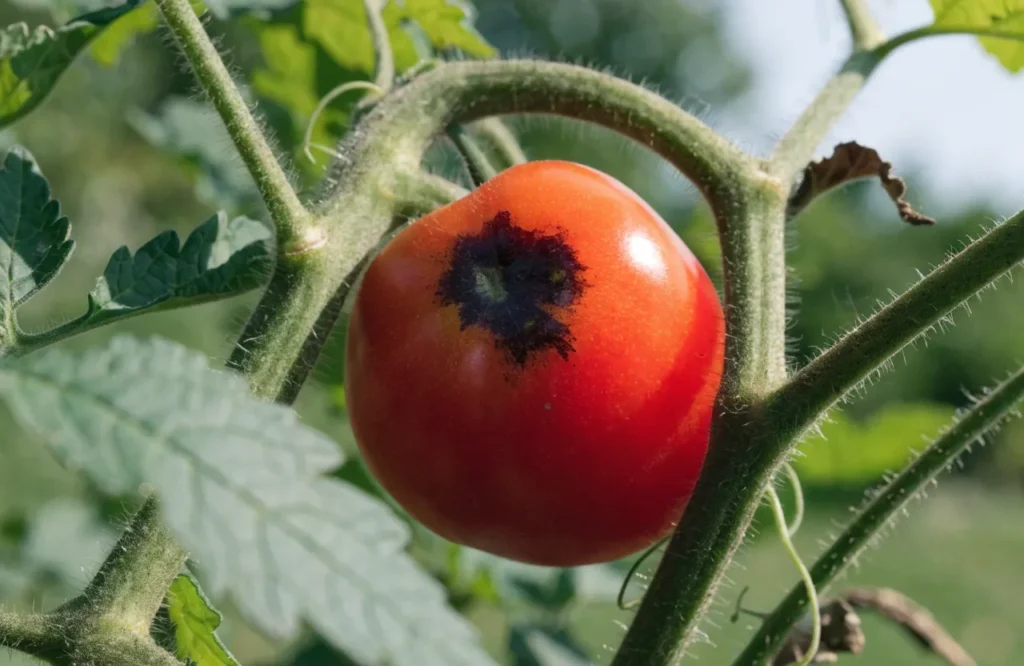
This is caused by insufficient calcium reaching the fruit, usually due to inconsistent watering rather than an actual lack of calcium in the soil. Dark, leathery, sunken patches form at the blossom end of the fruit.
Fix: Water deeply and on a consistent schedule, mulch to buffer soil moisture swings, and use a fertilizer lower in nitrogen and higher in phosphorus. Garden lime can help correct soil calcium levels over time. For a deeper dive into causes and fixes, see our full guide to blossom end rot.
Sunscald
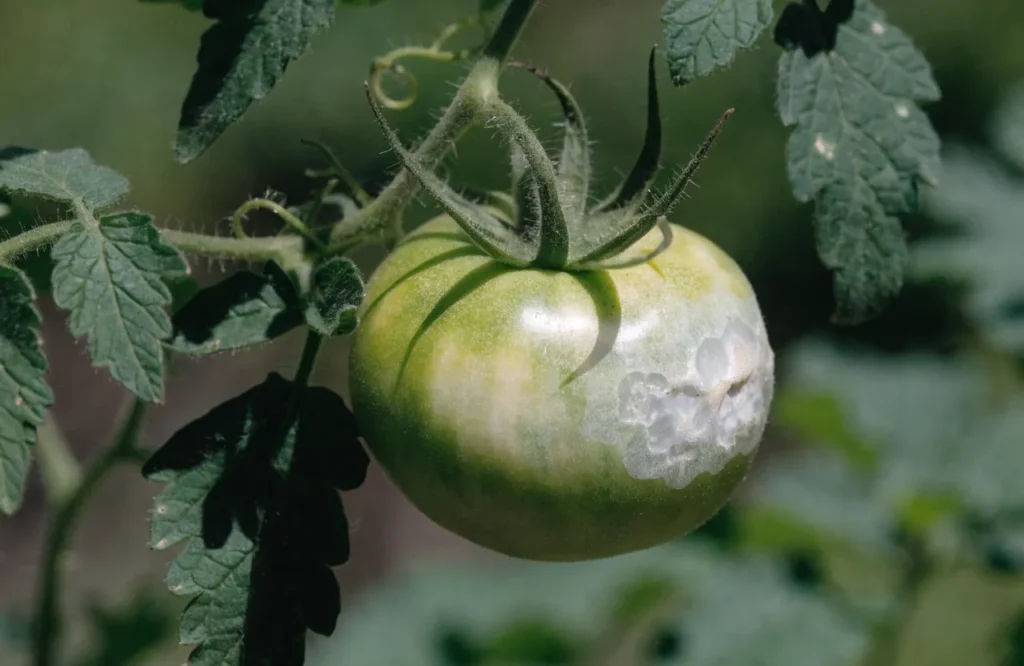
When fruit loses its leafy shade, from disease, over-pruning, or sudden exposure to full sun, it can develop pale, blistered, papery patches that later turn dark from secondary rot.
Fix: Keep plants full and healthy so foliage naturally shades fruit, avoid aggressive pruning, and use shade cloth in intense-sun climates.
Catfacing
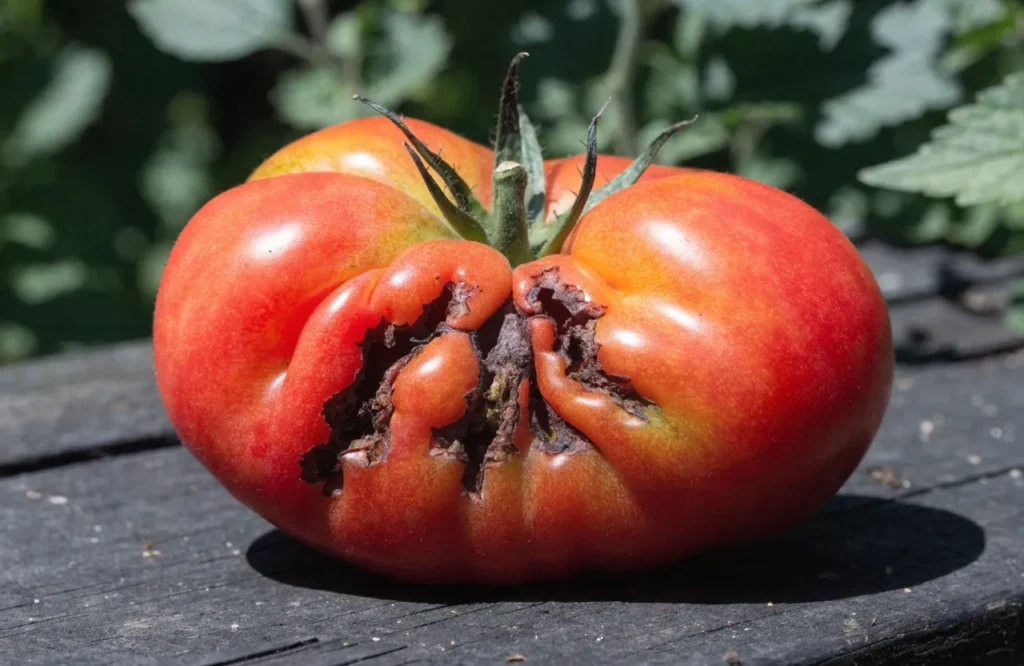
Misshapen fruit with deep scarring or holes near the blossom end, likely triggered by cool temperatures (below 50°F) during flower formation, though the exact cause isn’t fully understood. Large-fruited varieties are most prone.
Fix: Avoid over-pruning and excess nitrogen, and protect plants from cold snaps around flowering time.
Cracking and Zippering
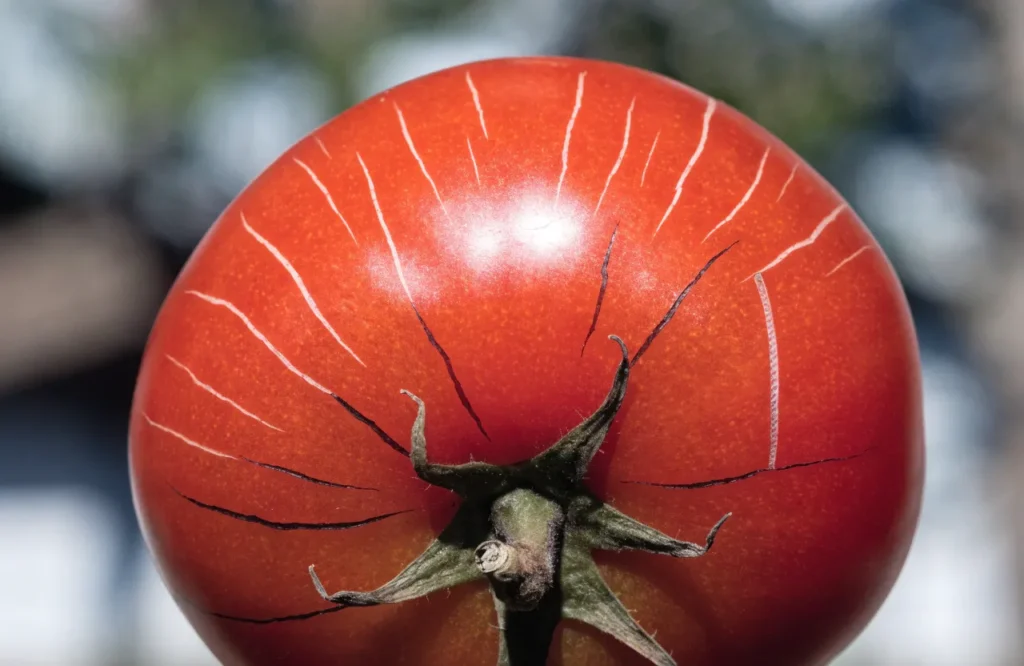
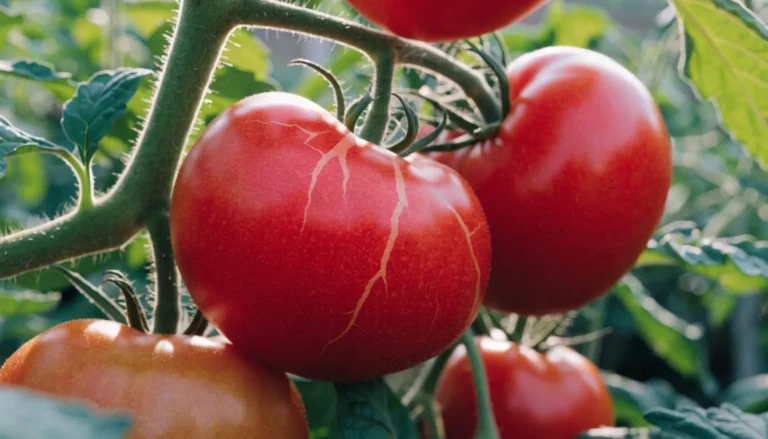
Radial or concentric cracks form when fruit takes up water faster than its skin can stretch, usually after heavy rain following a dry spell. Zippering, thin, zipper-like scars running from stem to blossom end, happens when flower parts stick to developing fruit, often in cool weather.
Fix: Water consistently to avoid moisture swings, mulch, and harvest before fruit fully ripens on the vine during unstable weather. Since inconsistent watering is the root cause of both cracking and blossom end rot, it’s worth reading how often you should actually be watering tomato plants rather than sticking to a fixed schedule.
Nutrient Deficiencies
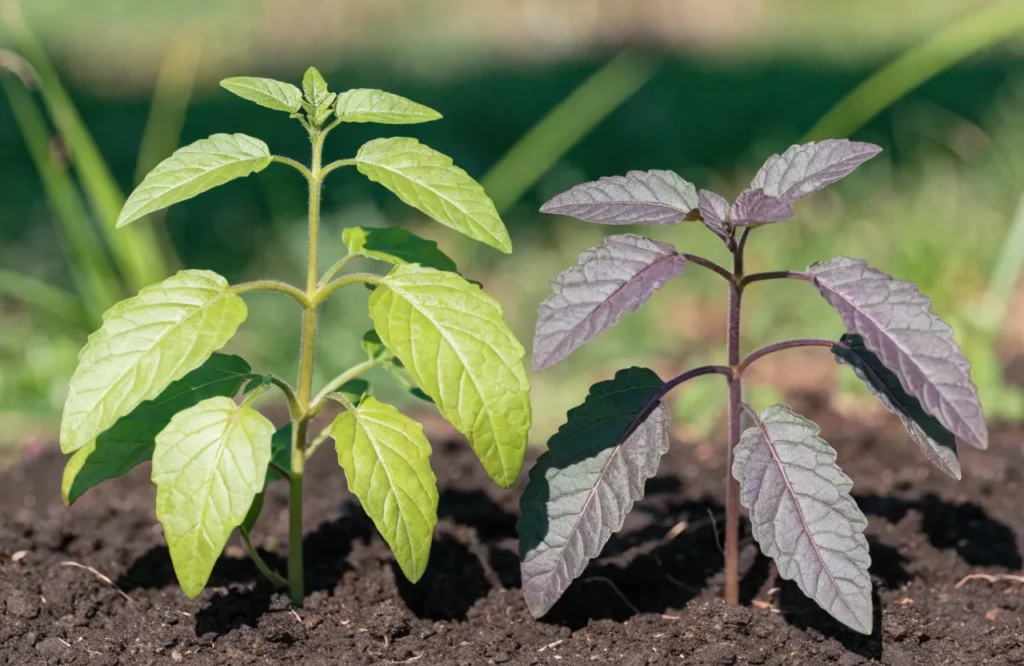
Purple-tinged leaves and stems usually point to phosphorus deficiency, common in young transplants and usually resolving once roots establish. Yellowing between leaf veins can indicate magnesium, potassium, or manganese deficiency, while a tomato plant turning yellow starting with the older leaves often signals nitrogen deficiency. A soil test is the most reliable way to confirm which nutrient is lacking before amending, and starting with the right soil mix for tomatoes and the right fertilizer prevents most of these deficiencies from developing in the first place. If yellowing is the main symptom you’re troubleshooting, our dedicated guide on why tomato plant leaves turn yellow covers all 18 possible causes in depth.
Root-Knot Nematodes
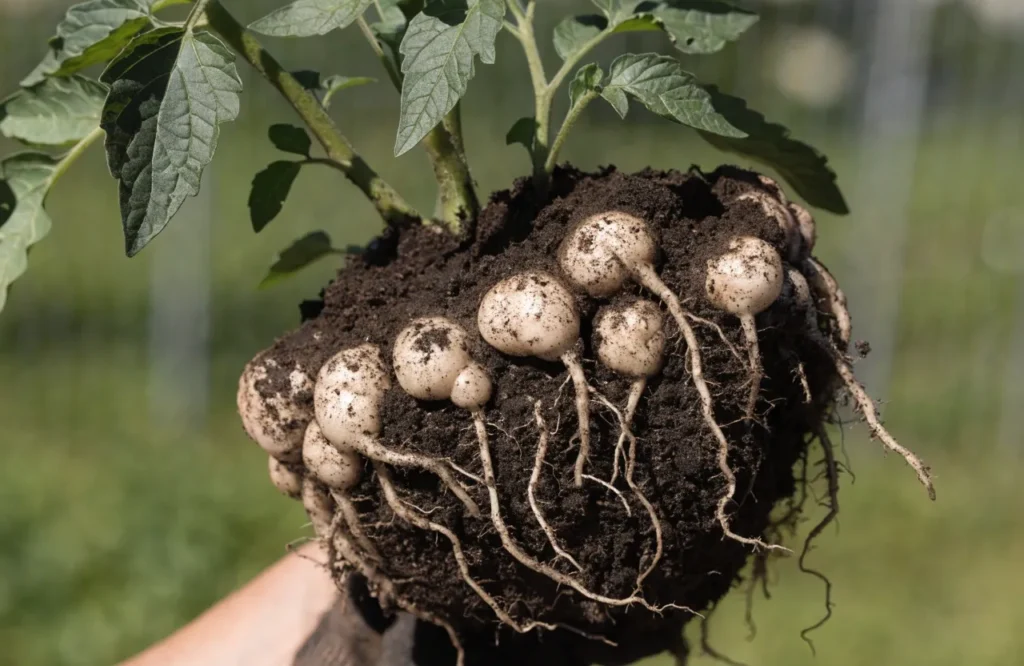
These microscopic roundworms live in soil and attack roots directly, causing swollen galls that stunt the plant and produce wilting that can be mistaken for disease.
Fix: Remove infected plants, rotate with non-host crops, and plant French marigolds nearby, which can help suppress nematode populations. Resistant varieties (labeled “N”) are the most reliable long-term solution. Marigolds are just one of several tomato companion plants worth planting alongside your crop for pest and disease suppression.
When to Remove the Plant
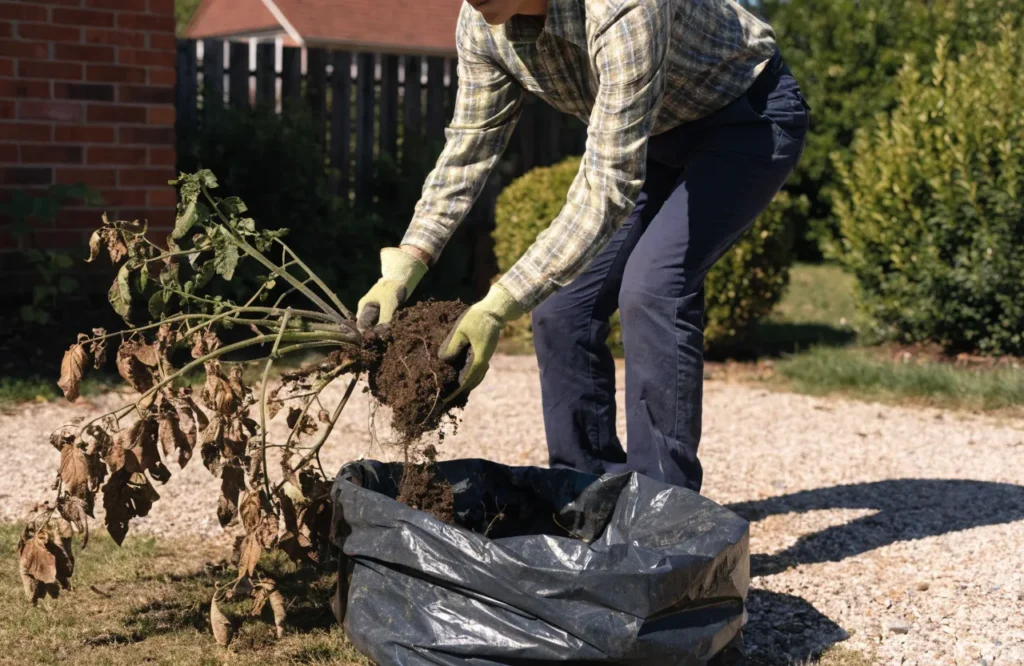
Pulling a tomato plant feels drastic, but leaving an incurable infection in the ground does more damage than losing one plant. Here’s how to tell when removal, rather than treatment, is the right call:
- The disease has no cure. Fusarium wilt, Verticillium wilt, bacterial wilt, bacterial canker, and any viral infection (mosaic virus, TSWV, TYLCV) can’t be reversed with fungicide or any other spray. Once confirmed, removal protects everything else in the garden.
- More than half the plant is affected. Even with treatable fungal diseases like early blight or Septoria leaf spot, if defoliation has progressed past the halfway point, the plant is unlikely to recover enough to produce a meaningful harvest, and it’s still shedding spores onto neighboring plants.
- The stem shows internal discoloration. Slicing open a stem and finding brown or black vascular tissue is a strong sign of a systemic, incurable wilt disease rather than a surface-level, treatable one.
- Symptoms appear on multiple plants within days. Rapid, simultaneous spread, especially with greasy leaf blotches or sudden wilting, usually signals late blight or bacterial wilt, both of which move faster than any treatment can keep up with.
- The plant is a known virus host and shows classic symptoms. Stunted, curled, mottled new growth with no leaf spots is the signature of a viral infection; there’s no reason to keep treating a plant that can’t be cured, and every day it remains is another day it can infect insects that carry the virus elsewhere.
When to hold off on removal: Physiological issues (blossom end rot, cracking, sunscald, catfacing) and manageable fungal diseases caught early (a few spotted lower leaves, not yet in the upper canopy) are worth treating and monitoring rather than removing. When in doubt, remove and destroy the worst-affected lower leaves first and reassess after a week before deciding on the whole plant.
Whenever a plant is removed for disease, pull it by the roots rather than cutting it at the soil line, bag it for trash rather than composting, and avoid planting anything in the Solanaceae family (tomatoes, peppers, potatoes, eggplant) in that same spot for at least two to three years.
Insect Pests Worth Watching For
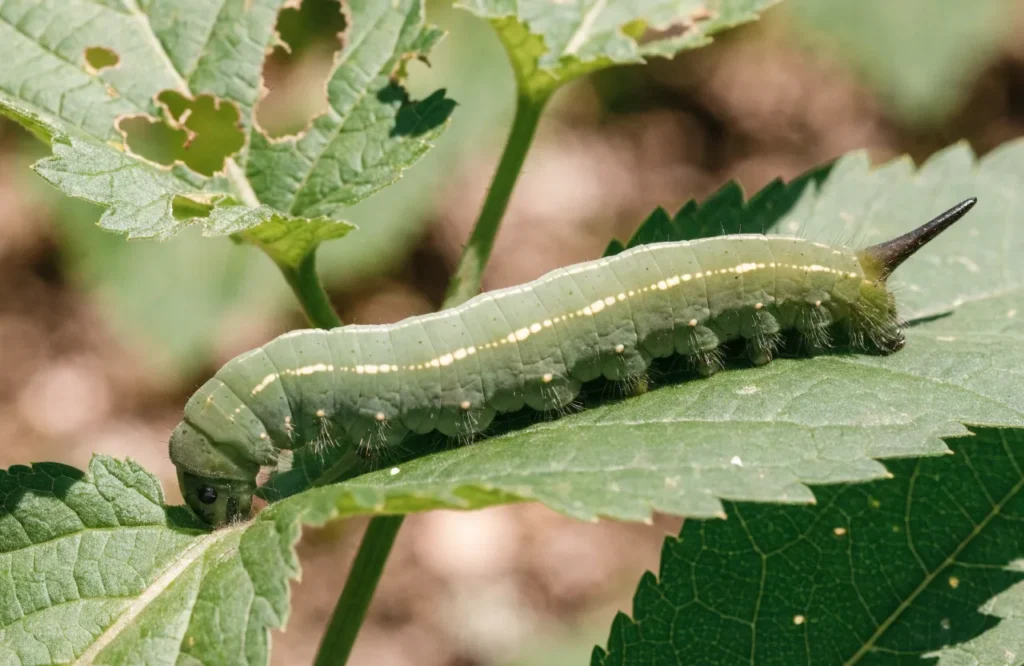
While not diseases themselves, several insects damage tomato plants directly and also spread viral infections:
- Aphids feed on sap and can transmit viruses; look for small, soft-bodied insects and sticky honeydew residue on leaves.
- Whiteflies spread Tomato Yellow Leaf Curl Virus and cause stippled, weakened leaves.
- Thrips transmit Tomato Spotted Wilt Virus and cause silvery, speckled foliage.
- Hornworms are large green caterpillars capable of stripping foliage overnight.
- Flea beetles riddle young leaves with small “shothole” holes.
- Stink bugs cause cloudy, discolored spots beneath the fruit’s skin.
- Spider mites cause fine yellow stippling and webbing, especially in hot, dry weather.
Cultural Practices That Prevent Most Tomato Problems
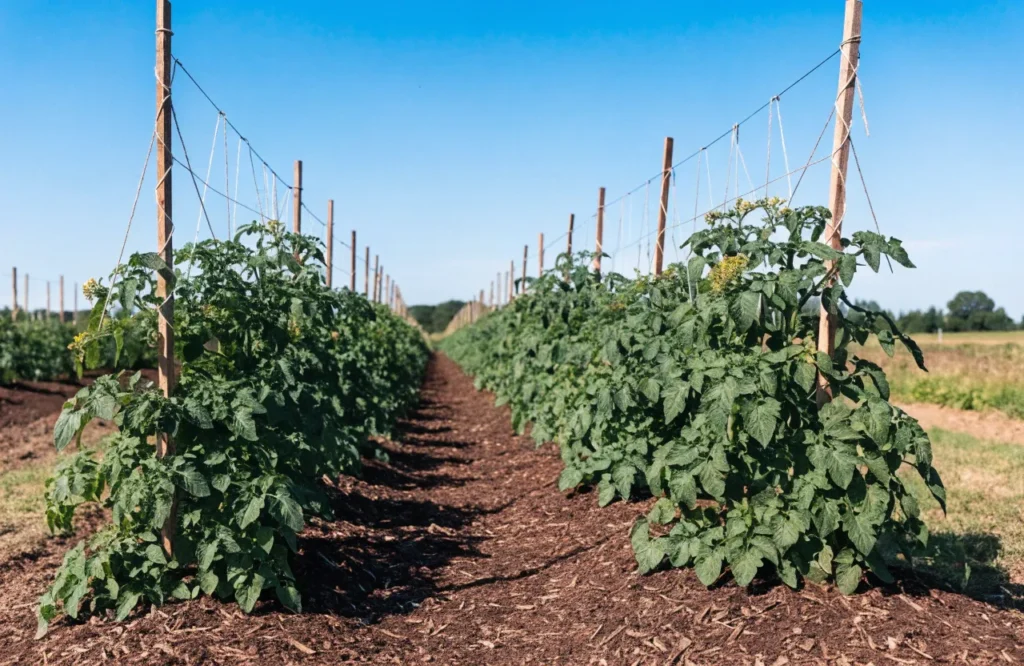
A large share of tomato plant disease can be avoided altogether with a few consistent habits:
- Rotate crops. Avoid planting tomatoes (or other nightshades like peppers, potatoes, and eggplant) in the same soil more than once every two to three years, and start each season with well-prepared, disease-suppressive soil.
- Water at the soil line. Overhead watering splashes fungal and bacterial spores onto leaves; drip irrigation or soaker hoses keep foliage dry. See how often you should water tomato plants for a schedule that adapts to weather rather than the calendar.
- Space, stake, and prune plants. Good airflow between plants dries leaves faster and discourages fungal growth. Our step-by-step tomato pruning guide covers exactly how and when to prune for healthier, more productive plants.
- Clean up debris. Fallen leaves and old plant material harbor spores and bacteria over winter, remove and dispose of them (don’t compost diseased material).
- Choose resistant varieties and companion plants. Seed packets and plant tags often list resistance codes such as V (Verticillium), F/FF (Fusarium races), N (nematodes), T (tobacco mosaic virus), and A (Alternaria/early blight). Pairing tomatoes with the right companion plants adds another layer of natural pest and disease defense.
- Sanitize tools. Clean pruners and stakes between plants, especially if you suspect infection.
- Feed wisely. Excess nitrogen produces lush, disease-prone growth and can worsen blossom end rot, a balanced tomato fertilizer applied in moderation is better than heavy feeding.
Seasonal Tomato Disease Calendar
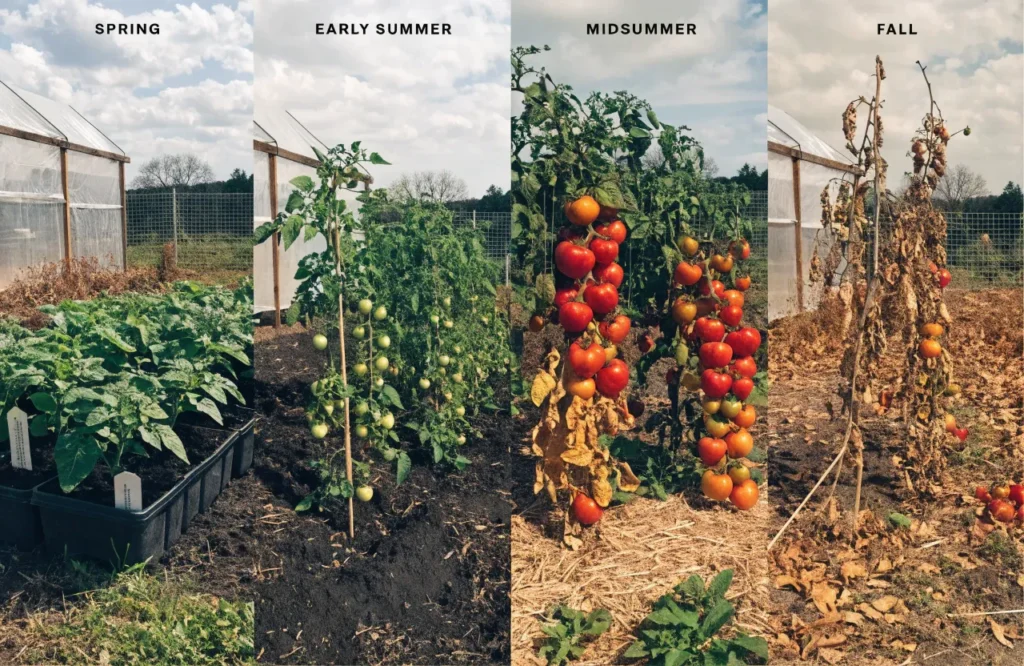
Disease pressure shifts as the growing season progresses, since different pathogens favor different temperature and moisture conditions. Here’s roughly what to watch for at each stage (timing will shift earlier or later depending on your climate).
| Season / Stage | What’s Most Likely | Why |
| Early spring (transplanting) | Cold injury, damping off, phosphorus deficiency (purple leaves) | Cool soil, cool nights, and young unestablished roots |
| Late spring (vegetative growth) | Flea beetles, aphids, herbicide drift, early bacterial speck | Tender new growth and cool, occasionally wet weather |
| Early summer (flowering, first fruit set) | Early blight, Septoria leaf spot, blossom end rot, catfacing | First fruit set is when calcium demand peaks and lower leaves start aging |
| Midsummer (peak fruiting, hot weather) | Powdery mildew, spider mites, sunscald, cracking, hornworms | Heat and moisture swings stress plants, and dense canopies trap humidity |
| Late summer / early fall (cooler, wetter) | Late blight, Botrytis (gray mold), leaf mold, buckeye rot, anthracnose | Cooler nights, morning dew, and heavier rain favor wet-weather fungi |
| Year-round (soil-persistent) | Fusarium wilt, Verticillium wilt, Southern blight, root-knot nematodes | These live in the soil and can emerge whenever conditions inside the root zone favor them |
Regional Climate Notes
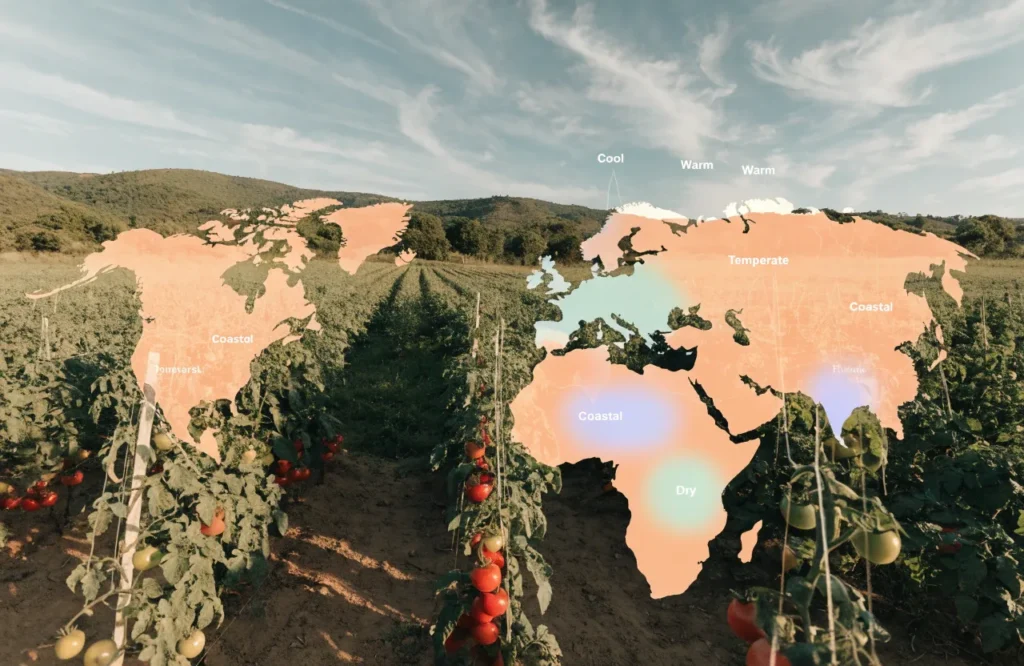
Because fungi, bacteria, and viruses each favor specific temperature and humidity ranges, the diseases that dominate your garden depend heavily on where you live.
- Hot, humid Southeast and Gulf Coast regions: Southern blight, bacterial wilt, buckeye rot, and bacterial spot are especially common due to high heat and humidity combined with acidic, sandy soils. Soil solarization and resistant varieties matter more here than almost anywhere else.
- Cool, wet Pacific Northwest and coastal regions: Late blight and leaf mold thrive in the persistent cool, damp conditions. Greenhouse or high-tunnel growing, along with strict airflow management, helps considerably.
- Hot, dry Southwest and interior West: Powdery mildew and sunscald are the bigger concerns, since fungal leaf-spot diseases that need free water on foliage are less common in arid conditions, but low humidity plus intense sun stresses plants and fruit directly.
- Humid Midwest and Northeast summers: Early blight and Septoria leaf spot are the most persistent yearly problems, often showing up together by midsummer as humidity and rainfall increase.
- Short-season northern climates: Cold injury, catfacing, and slow ripening are bigger practical issues than most diseases, since cool soil and short growing windows limit how much heat-loving pathogens can establish.
- Greenhouse and high-tunnel production: Leaf mold and powdery mildew are disproportionately common indoors, since humidity builds up without the natural airflow of an open garden, ventilation is the single most useful control tool in these setups.
A Few Tips From Experienced Growers
- Check the undersides of leaves, not just the tops. Leaf mold, spider mites, and early aphid colonies almost always show up on the underside first, days before symptoms are visible from above.
- Water in the morning, not the evening. Morning watering lets foliage dry out fully during the day; evening watering leaves leaves damp overnight, which is exactly when many fungal spores germinate.
- Don’t judge a stem by its outside. If a plant is wilting for no obvious reason, slice open a lower stem, vascular browning tells you it’s a systemic wilt disease before the whole plant tips you off with total collapse.
- Keep a “first blight” fungicide date each year. Many experienced growers start a preventive fungicide program right around first fruit set rather than waiting for the first spot to appear, since fungicides prevent new infection far better than they cure existing ones.
- A stressed plant is a magnet for disease. Uneven watering, root-bound transplants, and nutrient swings all lower a tomato plant’s natural resistance, steady, unspectacular care prevents more disease than any spray ever will.