11 Perennials to Divide in Fall for More Blooms Next Spring
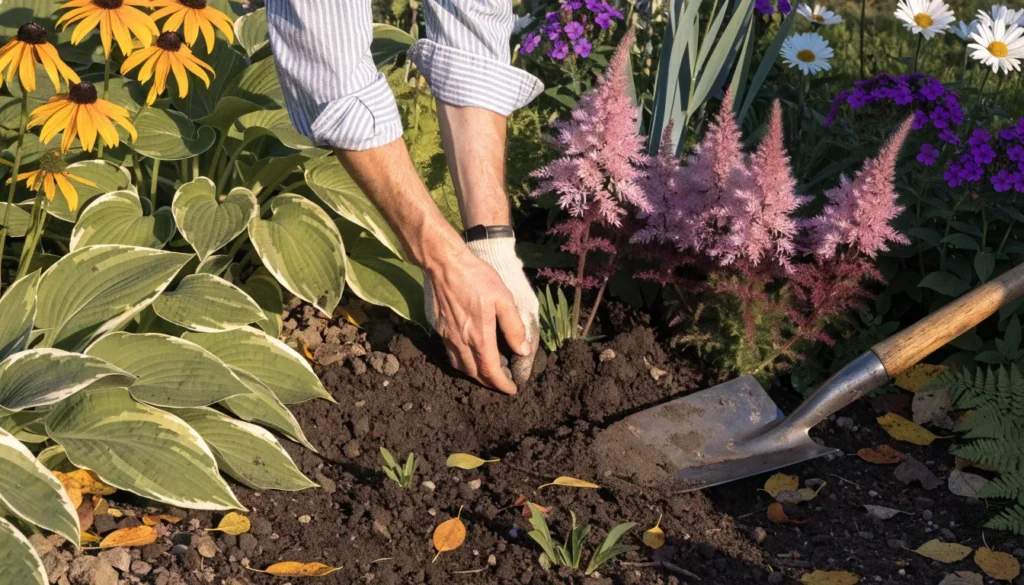
Fall is the best dividing season most gardeners never use. The soil is still warm, the air is cool, fall rain does half the watering for you, and the plant puts all its energy into roots instead of flowers. Divide the right perennials now, and they settle in before winter and come back bigger, healthier, and covered in blooms next spring.
Quick answer: The best perennials to divide in fall are hostas, daylilies, peonies, bearded iris, Siberian iris, astilbe, coral bells, coneflowers, black-eyed Susans, Shasta daisies, and garden phlox. Divide them 4 to 6 weeks before the ground freezes, keep each division’s roots attached to its own crown or buds, replant at the same depth, water well, and mulch after the soil cools.
If dividing is on your list this month, it sits right alongside the other jobs in our October garden checklist, a couple of weekends of fall work is what sets up the whole spring garden.
Table of Contents
At a Glance: The 11 Perennials to Divide in Fall
| Perennial | Divide every | Each division needs | Fall timing |
|---|---|---|---|
| Hosta | 3–5 years (or never, unless crowded) | 3+ eyes with roots | Early to mid-fall |
| Daylily | 3–5 years | 2–3 fans minimum | After flowering to mid-fall |
| Peony | Rarely; only when needed | 3–5 eyes + thick roots | Fall ONLY, early fall |
| Bearded iris | 3–4 years | 1 firm rhizome + leaf fan | Late summer to early fall |
| Siberian iris | 3–5 years | A chunk of crown with roots | Early fall |
| Astilbe | 3–4 years | Crown section with roots | Early fall |
| Coral bells (heuchera) | 3–4 years | Crown with roots attached | Early fall |
| Coneflower | 3–4 years | Several crowns + root section | Early fall |
| Black-eyed Susan | 2–3 years | Rooted section | Early to mid-fall |
| Shasta daisy | 2–3 years | Rooted crown section | Early fall |
| Garden phlox | 3–4 years | Outer section, 3–5 shoots | Early fall |
Why Divide Perennials in Fall?
Perennials are not plant-once-and-forget-forever plants. After a few years in the same spot, most clump-forming perennials start to decline, and dividing is how you reverse it. Here is what fall division does:
- Rejuvenates tired plants. Old clumps flower less and produce smaller blooms. Fresh divisions grow vigorously again.
- Fixes the dead center. Many perennials die out in the middle while the edges keep growing. Dividing removes the woody, unproductive center.
- Controls size. A plant that has swallowed its neighbors gets reset to a reasonable footprint.
- Improves airflow. Thinner clumps mean less powdery mildew and fungal disease, a constant battle with phlox and bee balm.
- Gives you free plants. One overgrown hosta can become five. Fill new beds, line a path, or share with neighbors at zero cost.
Signs a perennial is asking to be divided: fewer or smaller flowers than it used to make, a dead or bare patch in the center, stems flopping outward, the clump crowding out nearby plants, or roots pushing up out of the soil. If you spot two or more of these, the plant goes on your list of perennials to divide in fall.
Why fall instead of spring? Because the timing works with the plant, not against it. Spring-blooming and early-summer-blooming perennials have finished flowering, so you are not cutting off buds. The soil is warm from summer, which pushes fast root growth, while cool air and fall rain keep the divisions from drying out. Spring division, by contrast, asks a plant to rebuild roots and launch top growth at the same time.
When Exactly? Fall Division Timing by Zone
For every one of the perennials to divide in fall, one rule matters most: divide 4 to 6 weeks before the ground freezes hard, so roots can anchor before winter. That window lands differently depending on where you garden:
| Zone | Best fall division window |
|---|---|
| Zones 3–4 | Late August to mid-September |
| Zones 5–6 | Early September to early October |
| Zones 7–8 | Mid-September to late October |
| Zones 9–10 | October to early November, once heat breaks |
Earlier is safer than later, especially in cold zones. A division planted too late cannot root in before freeze-up and may be pushed out of the soil by frost heave (more on that in Aftercare below). Pick a mild, overcast day if you can, and water the plants deeply a day or two beforehand, hydrated roots divide more easily and recover faster.
Dividing is just one part of getting the beds ready for the cold. Our guide on how to prepare your garden for fall walks through the full sequence, from cleanup to soil care, so you can batch these jobs together.
The 11 Perennials to Divide in Fall
1. Hosta
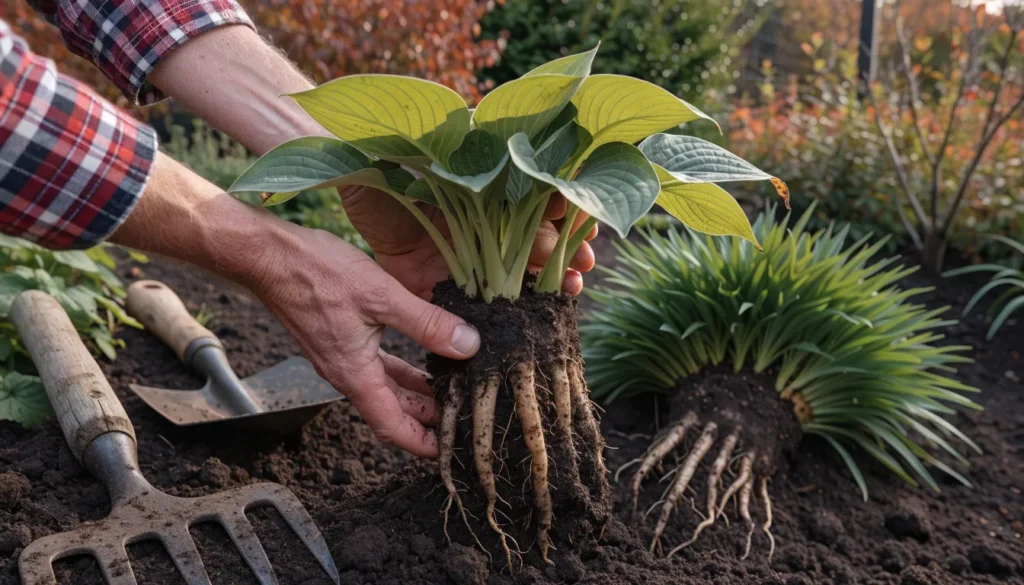
Hostas are the easiest fall division of all, tough, forgiving, and almost impossible to kill with a spade. Their foliage is fading by fall, so you can see the crown clearly and work without fighting a full canopy of leaves.
- How often: Every 3–5 years, or only when the clump is crowded. Hostas tolerate years of neglect, so divide for new plants or space, not on a strict schedule.
- How to divide: Lift the whole clump with a fork, then cut straight down through the crown with a sharp spade or knife. For more plants, pry the crown apart into sections.
- Division size: At least 3 eyes (growing points) with a good fistful of roots each. Single-eye pieces survive but take much longer to look like anything.
- Pro tip: Replant at exactly the same depth the clump was growing. Hostas planted too deep are prone to crown rot in wet spring soil.
2. Daylily (Hemerocallis)
If you have never divided a perennial, start here. Daylilies have dense, fibrous, almost indestructible root systems, and fall division after flowering restores their bloom power dramatically the following summer.
- How often: Every 3–5 years, when flowering drops off or the clump gets congested.
- How to divide: Dig the clump, shake or wash off the soil, and pry it apart with two garden forks placed back to back in the center. Very dense clumps can be cut with a spade.
- Division size: 2–3 fans per division for propagation; 5–7 fans if you want a full-looking plant in its first year.
- Pro tip: Trim the foliage back by about half (to roughly 6 inches) before replanting. It balances the cut roots and stops the fans flopping while they settle.
3. Peony
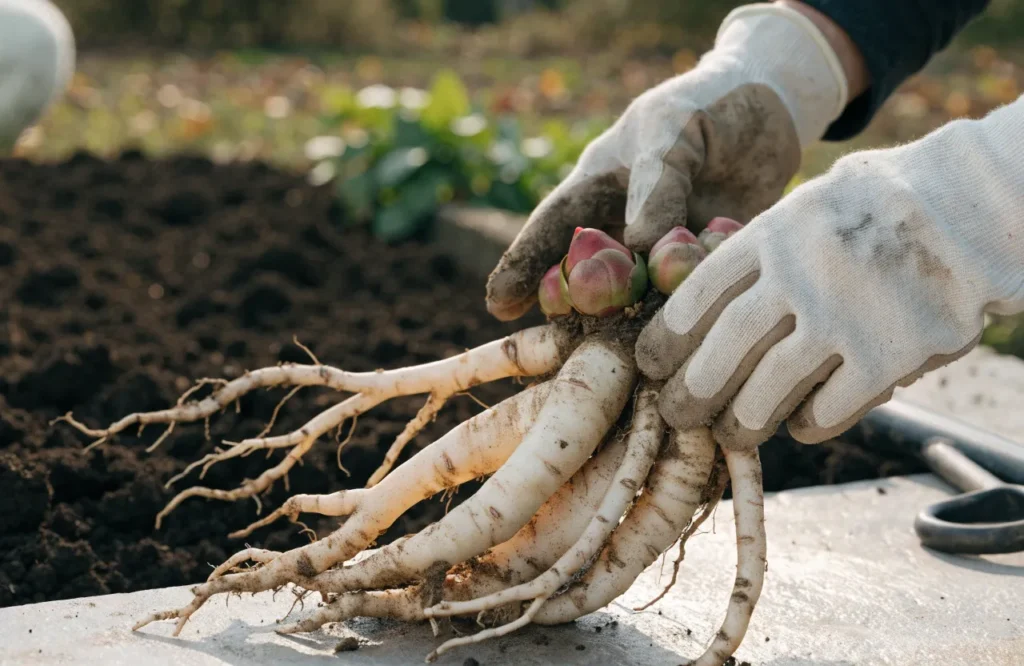
Peonies are the one plant on this list where fall is not just the best time, it is the only time. Peonies resent disturbance, live for decades, and should only be divided when a clump is truly overcrowded, flowering poorly, or being moved. But when you must divide, do it in early fall.
- How often: Rarely. A happy peony can go 10+ years untouched.
- How to divide: Cut the foliage down, lift the clump carefully, and wash the roots completely clean so you can see the pink buds (“eyes”) on the crown. Cut with a sharp knife into sections.
- Division size: 3–5 eyes per division, with thick, healthy roots attached. Pieces with only 1–2 eyes can take years extra to flower.
- Pro tip: Planting depth decides everything. Set the eyes just 1–2 inches below the soil surface — deeper than that is the number one reason a divided peony refuses to bloom. Expect 2–3 years before a division flowers at full strength; that is normal, not failure.
4. Bearded Iris
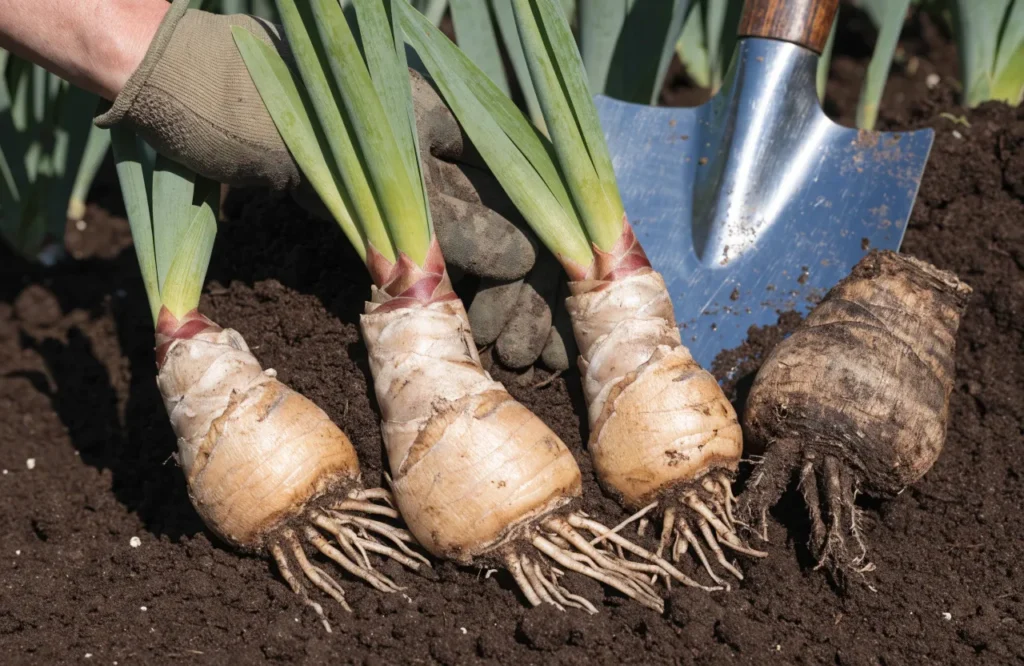
Bearded iris rhizomes multiply fast, and crowded clumps quickly turn into a tangle of old, non-flowering wood. Late summer to early fall, after flowering, while there is still time for roots to grow, is the traditional and best division window.
- How often: Every 3–4 years.
- How to divide: Lift the clump and separate the rhizomes at their natural joints. Keep the young, firm rhizomes from the outer edge; discard the old, woody center pieces and anything soft or rotted.
- Division size: One firm rhizome with roots and a fan of leaves, trimmed to a 4–6 inch fan.
- Pro tip: Check for iris borer damage (soft, smelly, hollow rhizomes) and cut it all away. Replant rhizomes shallow, with the top of the rhizome at or just above soil level, buried rhizomes rot and refuse to flower.
5. Siberian Iris
Siberian iris forms dense, grassy clumps that slowly die out in the center. Early fall division keeps them vigorous, but be warned, an old clump is one of the toughest things in the garden to split.
- How often: Every 3–5 years, when the center thins or flowering drops.
- How to divide: Soak the lifted clump in a bucket of water for an hour to soften it, then work it apart with a sharp spade, an old saw, or two forks. Cut out and discard the dead center.
- Division size: A solid chunk of crown roughly a fist across, with roots and several shoots.
- Pro tip: Never let Siberian iris divisions dry out. Keep them in a bucket of water while you work and replant the same day, dry roots are the main reason divisions fail.
6. Astilbe
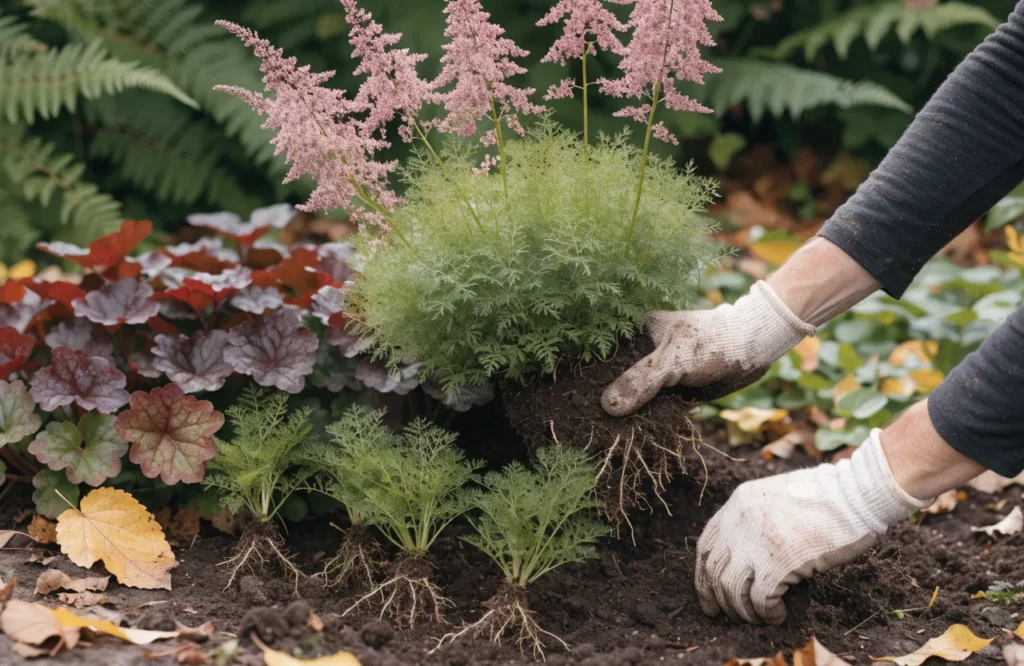
Astilbe crowns grow upward and get woody with age, and flowering fades as the clump exhausts itself. Early fall division (spring works too) resets the plant, just do not leave it until late fall, because astilbe needs time to re-root before hard cold.
- How often: Every 3–4 years.
- How to divide: Lift the clump and cut the crown into sections with a sharp knife or spade, cutting away the oldest, woodiest middle.
- Division size: Each section needs a piece of crown with roots and at least a few buds.
- Pro tip: Astilbe is a moisture lover. Water divisions faithfully through fall, this is one plant that should never dry out while it is re-establishing.
7. Coral Bells (Heuchera)
Coral bells have a habit no one warns you about: their crowns grow up and out of the soil on short woody stems, until the plant looks like it is sitting on stilts and starts to heave out of the ground in winter. Fall division fixes it.
- How often: Every 3–4 years, or whenever the crowns have risen noticeably above soil level.
- How to divide: Lift the plant and pull or cut the crown apart into sections, each with roots attached. Trim away bare woody stem.
- Division size: A rooted crown section, even modest pieces establish well.
- Pro tip: Replant divisions slightly deeper than they were growing, so the crown sits at soil level again, and mulch well. This one fix adds years to a heuchera’s life.
8. Coneflower (Echinacea)
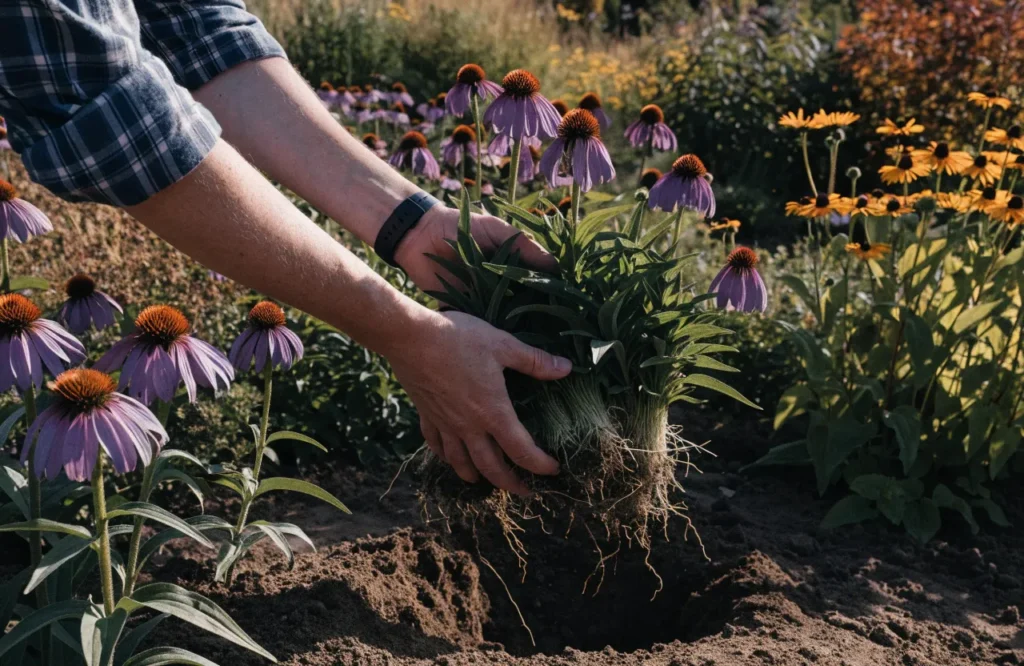
Coneflowers are short-lived perennials that stay productive longer when divided every few years. Early fall division works well in most zones, the key word is early, while there are still several weeks of growing weather left for roots to establish.
- How often: Every 3–4 years.
- How to divide: Lift carefully with a fork, established plants have surprisingly deep roots. Cut the crown into sections, each with several crowns and a solid piece of root.
- Division size: A section with multiple crowns; tiny single-crown pieces are slow and sulky.
- Pro tip: Expect divisions to wilt dramatically for the first week or two, then recover. Water consistently and do not panic. Leave the seed heads standing on any coneflowers you are not dividing, goldfinches feed on them all winter, and the plants that survive frost and feed wildlife earn their space twice over, much like the hardy crops in our guide to vegetables that survive frost.
9. Black-Eyed Susan (Rudbeckia)
Black-eyed Susans spread enthusiastically, and a clump that is not divided every few years starts crowding itself and everything around it. Fall division is quick, easy, and gives you armfuls of free plants.
- How often: Every 2–3 years.
- How to divide: Lift the clump and pull or cut it into rooted sections. This is one of the most forgiving divisions in the garden.
- Division size: Any rooted section with a crown and a few shoots.
- Pro tip: Use the extras to fill gaps fast, divisions planted into empty spots or pots give you next summer’s drifts for free. Spare divisions also transplant beautifully into fall containers; see our fall container gardening ideas for combinations that carry color right up to hard frost.
10. Shasta Daisy (Leucanthemum × superbum)
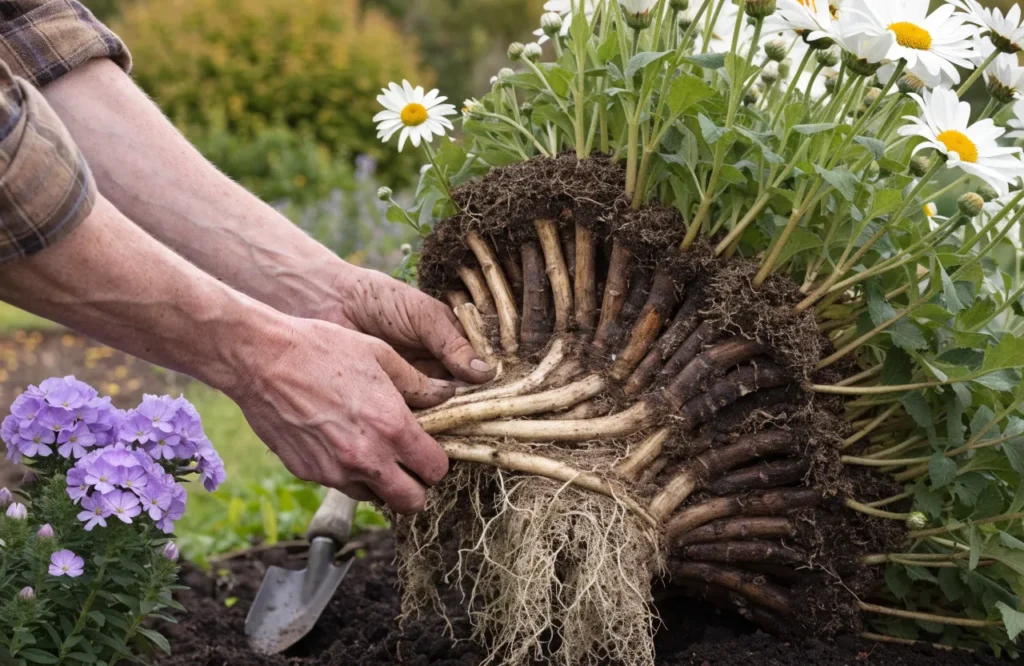
Shasta daisies are short-lived, and division is the difference between a plant that fades out in year three and one that keeps coming back. Every 2–3 years is not optional maintenance for this plant, it is life support.
- How often: Every 2–3 years.
- How to divide: Lift the clump in early fall and separate the outer, young rosettes from the woody center. Discard the center, it is spent.
- Division size: Each rosette section with its own roots.
- Pro tip: Divide in early fall rather than late. Shasta daisy divisions need a solid root run before winter; in cold zones, spring division is the safer backup plan if you missed the early-fall window.
11. Garden Phlox (Phlox paniculata)
Garden phlox mildews in crowded, airless clumps. Dividing every few years, and throwing away the tired center, is the single best cultural fix for both vigor and mildew.
- How often: Every 3–4 years.
- How to divide: Lift the clump and cut it into sections from the vigorous outer growth, each with 3–5 shoots and healthy roots. Discard the woody middle entirely.
- Division size: Outer sections with several shoots; bigger divisions recover fastest.
- Pro tip: If the parent plant showed powdery mildew this year, clean up every fallen leaf around it and do not compost the debris. Fall cleanup is where next year’s disease pressure is decided, it is one of the most common fall gardening mistakes gardeners make.
Also Worth Dividing in Early Fall
Beyond the main 11 perennials to divide in fall, these also divide well in early fall once the spade is out: yarrow (every 2–3 years, discard the woody core), coreopsis, hardy geranium (cranesbill), bee balm (fall or spring; division is its mildew fix too), salvia, Asiatic lilies (after the foliage yellows), catmint, and sedum like ‘Autumn Joy’ (early fall only, in cold zones, spring is safer). Fall is also when you handle the season’s other planting jobs, from bulbs to garlic, our guide on how to plant spring bulbs covers the other half of the fall planting weekend.
How to Divide Perennials: Step by Step
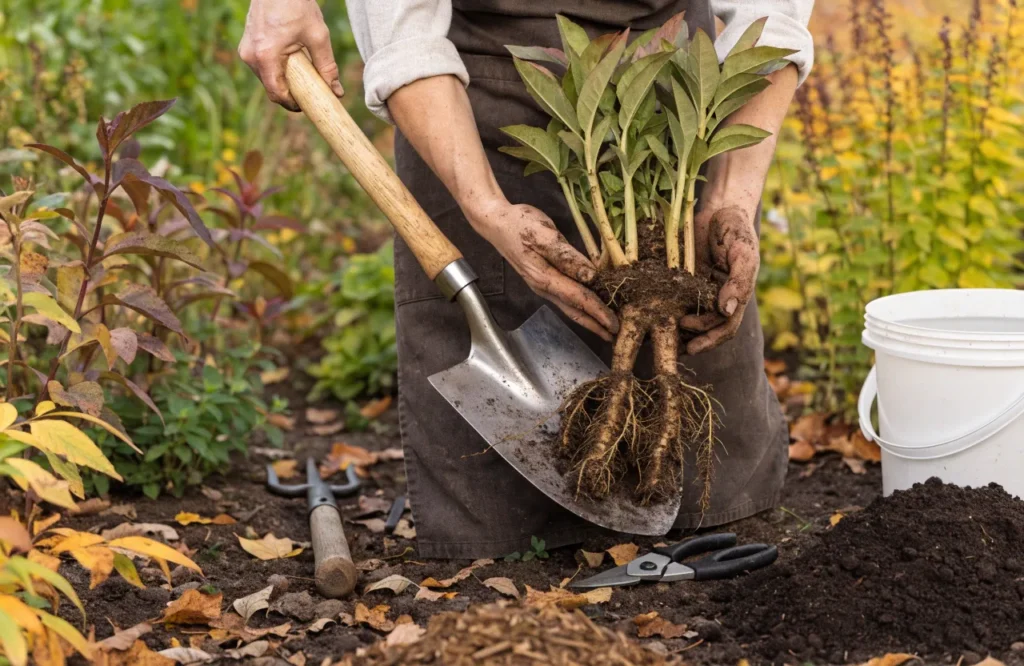
The method is the same for almost every plant on this list of perennials to divide in fall. Master it once and you can divide anything.
You will need: a sharp spade, a garden fork (two for big clumps), a soil knife or old serrated knife, pruners, a hose or bucket of water, compost, and mulch.
- Water the day before. Water the plant deeply 1–2 days before dividing. Hydrated roots are flexible, the soil digs easily, and the plant handles the shock far better.
- Cut the foliage back. Trim top growth to about 6 inches (roughly half). It makes the clump manageable and reduces water loss while roots regrow. Iris fans get trimmed to a 4–6 inch fan shape.
- Dig wide and lift. Push a fork or spade into the soil in a circle around the plant, a few inches outside the crown, and lever the whole clump up with as much root intact as possible.
- Shake, wash, inspect. Knock or hose the soil off the roots. You need to see the crown, where the buds, eyes, and natural split points are, before you cut anything.
- Make the divisions. For fibrous clumps, drive two forks back to back into the center and lever them apart. For tough crowns, cut with a spade or knife. Aim for 2–4 large divisions for a fast-established look, or more, smaller pieces (each with buds/eyes plus roots) for maximum new plants.
- Clean up each piece. Cut away anything dead, woody, mushy, or diseased, old centers, rotted rhizomes, hollow stems. Only healthy tissue goes back in the ground.
- Replant immediately, at the same depth. Dig a hole wider than the division, work compost into the soil, and set the division at exactly the depth it was growing before (peonies and bearded iris are the exceptions with their own depth rules above). Firm the soil around the roots, no big air pockets.
- Water deeply and mulch. Soak each division right after planting. If you must wait before replanting, keep divisions shaded and covered with wet newspaper or burlap, or heel them into a temporary spot, roots must never dry out in the sun and wind.
Perennials NOT to Divide in Fall (Wait for Spring)
Not every perennial belongs on the list of perennials to divide in fall. Fall-blooming perennials should finish their show undisturbed, and a few plants simply resent fall root disturbance. Divide these in spring instead:
| Wait for spring | Why |
|---|---|
| Asters | Fall-blooming, dividing now cuts the display and leaves no recovery time |
| Hardy mums (chrysanthemums) | Fall-blooming; spring divisions establish far better |
| Goldenrod | Fall-blooming; divide as new growth emerges in spring |
| Japanese anemone | Flowers into fall; spring division avoids interrupting bloom |
| Ornamental grasses (most) | Many resent fall division, especially in cold zones, spring, as growth starts, is safer |
| Lavender & Russian sage | Woody, Mediterranean roots dislike cold, wet winter soil after disturbance |
| Bleeding heart | Dormant and invisible by fall, you cannot see the buds you are cutting |
| Baptisia & butterfly weed | Deep taproots resent disturbance at any time; propagate from seed instead |
The general rule behind the table: divide a perennial in the opposite season from when it blooms. Spring and early-summer bloomers divide in fall; late-summer and fall bloomers divide in spring.
Aftercare: Getting Divisions Through Winter
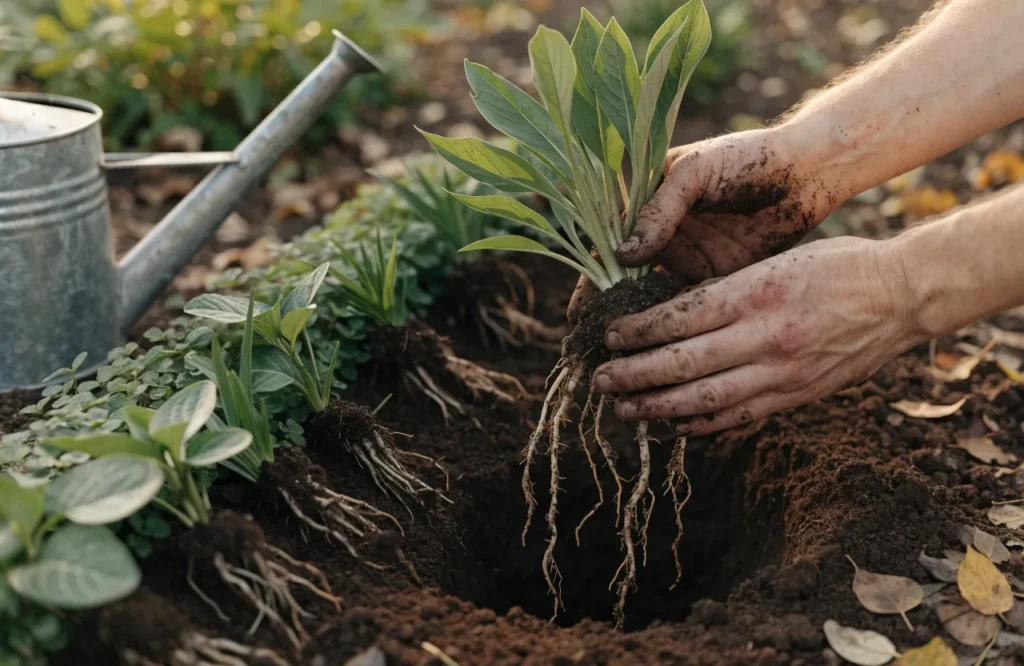
For perennials to divide in fall, division is only half the job. What happens in the weeks after decides whether your new plants thrive or heave out of the ground in January.
- Water until the ground freezes. Divisions need consistent moisture while roots grow, roughly an inch of water a week if fall rain falls short. Keep watering until freeze-up, not just for the first week.
- Mulch, but not yet. Wait until the soil has cooled and the first light frosts have arrived, then apply 2–3 inches of shredded leaf or straw mulch around (not smothering) the crowns. Mulching too early, while the soil is warm, invites voles and rot.
- Beat frost heave. The biggest killer of fall divisions in cold zones is freeze-thaw cycling: the soil expands and contracts and literally pushes shallow-rooted new divisions out of the ground. A steady mulch blanket keeps soil temperature even and stops the heaving. Check divisions after mid-winter thaws and gently firm any that have lifted back into contact with the soil.
- Skip the fertilizer. Do not feed fresh divisions in fall. Fertilizer pushes soft top growth that winter will burn, and stressed roots cannot use it anyway. The compost worked in at planting time is enough until spring.
- Protect the tender ones. Divisions of marginally hardy plants, and anything planted late, benefit from the same protection routine you use for the rest of the garden, see our guide to protect plants from frost for cover options and temperature thresholds.
5 Mistakes That Kill Fall Divisions
These five mistakes account for nearly every failed division, and they apply to all of the perennials to divide in fall, from the toughest daylily to the fussiest peony.
- Dividing too late. A division with no time to root before the ground freezes spends winter unanchored. If your 4–6 week window has closed, leave the plant alone and divide in spring.
- Making divisions too small. A single eye or one thin fan may survive, but it will take seasons to perform. When in doubt, divide bigger, 3–5 eyes or fans per piece is the reliable range.
- Planting at the wrong depth. Too deep smothers crowns and stops peonies blooming; too shallow exposes roots to frost heave. Same depth as before, every time, with the two noted exceptions.
- Letting roots dry out. Twenty minutes of sun and wind on exposed roots can undo everything. Work in shade, keep a bucket of water handy, and replant the same day.
- Replanting the dead center. The woody middle of an old clump is spent, that is the part you are dividing to get rid of. Compost it and plant only the vigorous outer growth.
Frequently Asked Questions
The Bottom Line
Dividing is the cheapest upgrade in gardening: no purchase, one afternoon, and a border full of rejuvenated plants plus spares to fill every gap. Work through the 11 perennials to divide in fall, hostas, daylilies, and iris if you only have an hour; peonies in early fall if you only do one job, keep the 4–6 week rule in front of you, water and mulch the divisions properly, and next spring the garden will show you exactly why fall is dividing season.
Divide on a cool weekend, then finish the rest of the season’s jobs while you are out there: the same beds you open up for dividing are ready for bulbs, mulch, and a final tidy. Work through our October garden checklist and the full prepare your garden for fall guide, and both this fall’s divisions and next spring’s blooms are taken care of.